DPRK-Linked XCTDH Uses Ethereum Transfers to Rotate Malware C2
Threat Actor Intelligence · 4 sources · Updated 2mo ago · First seen Sep 26, 2026
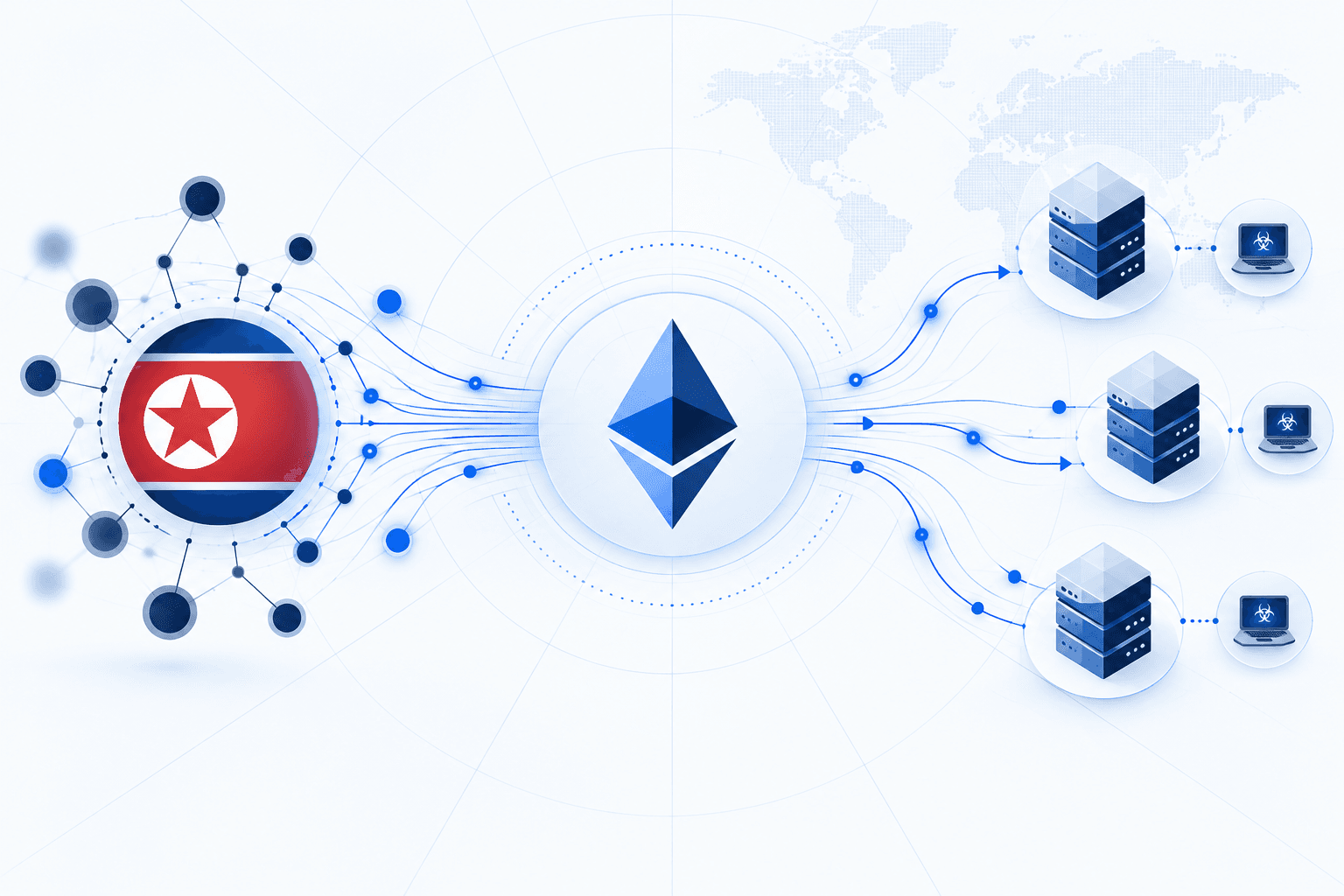
A DPRK-linked XCTDH campaign targeting cryptocurrency and software developers has added an Ethereum-based command-and-control recovery mechanism, HashHiding, to its existing multichain infrastructure. Malware scans transactions from a designated Ethereum signal wallet and decodes a replacement C2 IPv4 address and port from the recipient address of ordinary coin transfers, allowing operators to rotate infrastructure without updating malware. Researchers observed 2,655 Ethereum beacon transactions and four C2 rotations; HashHiding operates alongside hardcoded C2 servers and a TRON/Aptos-to-BNB Smart Chain payload-resolution chain.
The operators use fake job offers, poisoned GitHub repositories, and trojanized NPM packages to deliver the Node.js-based DEV#POPPER.js RAT and OmniStealer credential harvester across Windows, macOS, and Linux. The RAT can execute commands and collect keystrokes and clipboard data, while OmniStealer targets browser, password-manager, cloud-storage, and cryptocurrency-wallet data. The activity reflects broader adoption of blockchain dead drops—public-chain transactions, smart contracts, or wallets used to carry C2 instructions or payload pointers—by DPRK, Iranian, and criminal operators, making conventional server blocklisting insufficient without detecting the initial developer-targeting infection chain and blockchain-resolution behavior.
Why it matters
Impact assessment
XCTDH is a DPRK-linked, cross-platform campaign targeting cryptocurrency and software developers through fake recruitment, poisoned GitHub repositories, and trojanized NPM packages. A successful infection provides remote command execution and access to browser, password-manager, cloud-storage, and cryptocurrency-wallet data, creating material risk of credential theft, cryptocurrency theft, source-code exposure, and developer-workstation compromise.
- Affected environments: Windows, macOS, and Linux developer endpoints, especially those with Node.js, VS Code/Cursor, cryptocurrency wallets, or cloud-development credentials.
- Scope: Targeted initial access against developers, but the delivery mechanisms are broadly reusable across organizations that consume public code repositories and packages.
- Resilience: Ethereum-based C2 recovery allows operators to rotate destinations without redeploying malware. Blocking a single C2 IP is insufficient.
- Known exploitation: Researchers observed active Ethereum signaling from 23 June through 21 September 2026, comprising 2,655 beacon transactions and four C2 rotations. The number of compromised hosts and amount of stolen data are not known.
Supporting facts
- DEV#POPPER.js supports remote command execution, keystroke capture, clipboard monitoring, and persistence through VS Code/Cursor IDE injection.
- OmniStealer targets browser data, password managers, cloud-storage credentials, and 153 cryptocurrency wallets.
- Stolen data is exfiltrated through a messaging-bot interface.
- The campaign retains three concurrent resolution channels: hardcoded C2, TRON/Aptos-to-BNB Smart Chain payload retrieval, and Ethereum HashHiding C2 recovery.