Phishing Campaign Abuses Legitimate RMM Tools for Remote System Control
Social Engineering & Fraud · 4 sources · Updated 3mo ago · First seen Feb 5, 2026

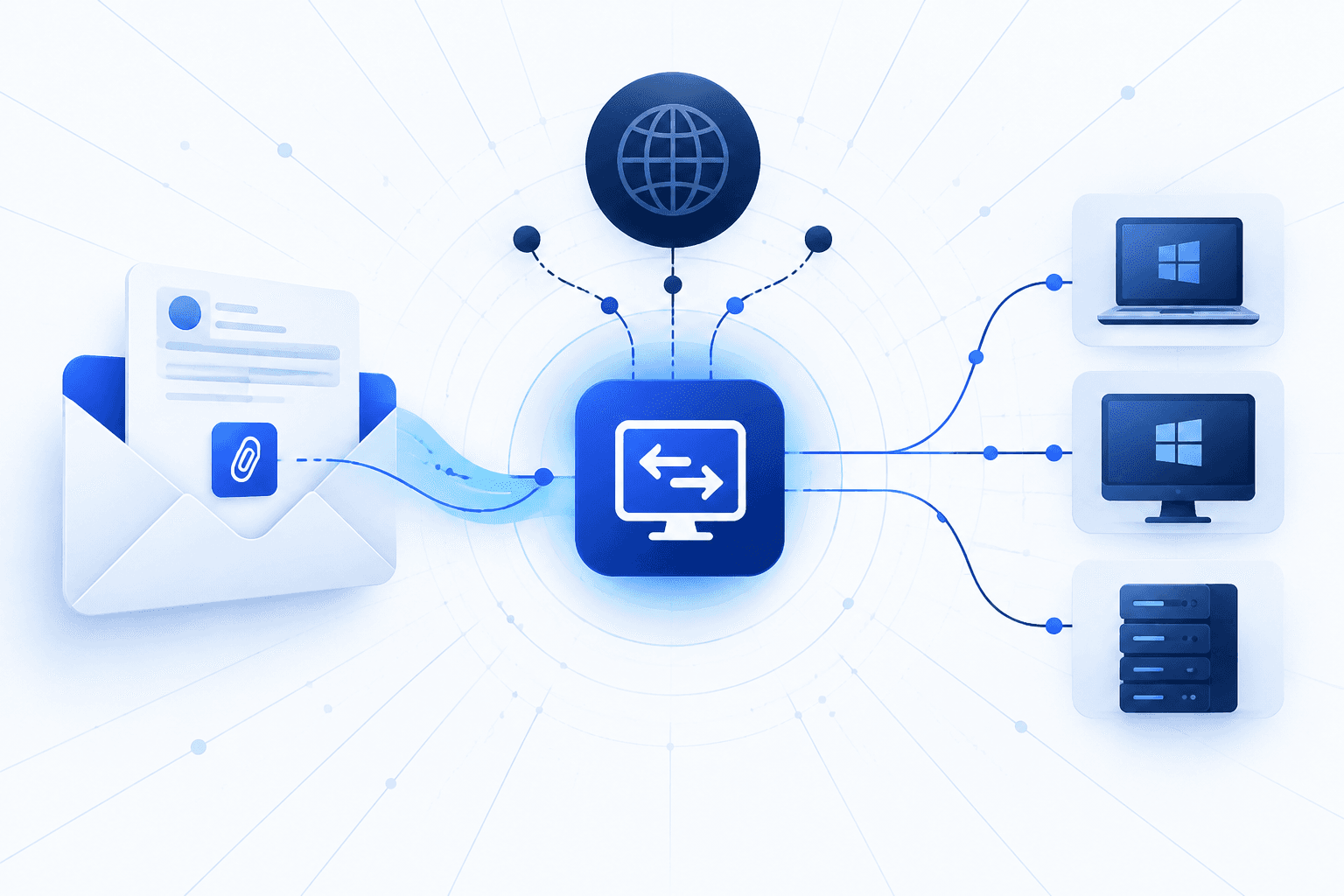
A phishing campaign active since January 2026 has targeted victims in 46 countries—45% of observed activity involved the United States—using tax forms, Social Security notices, invoices, VAT, shipping, Adobe PDF, and shared-file lures. Victims are sent to short-lived pages hosted on services including Vercel, Netlify, Amazon S3, and DigitalOcean Spaces, or on compromised sites, then prompted to download password-protected ZIP archives. The archives use a VBS-to-PowerShell chain to retrieve signed installers for legitimate remote monitoring and management (RMM) products, giving operators interactive access without relying on conventional malware.
The operators rotate among GoTo Resolve, LogMeIn Rescue, ScreenConnect, ConnectWise, and ITarian, limiting the value of product-specific blocking. Researchers identified 425 delivery-kit URLs across 240 hosts between February 5 and July 29, with 94% of hosts remaining live for only one day; stable kit artifacts included fmtt font files, font1.woff2, icons8-microsoft-word-94.png, and a secure.html-to-ZIP delivery chain. Organizations should detect and investigate unauthorized RMM deployments, particularly script-initiated PowerShell downloads of MSI installers, newly installed support software, and password-protected ZIP files delivered through phishing pages.
Why it matters
Summary
An active phishing campaign has targeted organizations in 46 countries since January 2026, using document-themed lures to install legitimate RMM agents and give operators interactive remote control. The observed activity is U.S.-focused, with 45% of activity associated with the United States; education, technology, government, banking, manufacturing, and finance are among the targeted sectors.
Impact
- Successful execution gives an external operator hands-on-keyboard access through signed, commercially legitimate remote-access software, enabling system reconnaissance, command execution, credential theft, data exfiltration, ransomware staging, and lateral movement.
- The exposure is broad rather than narrowly targeted: the campaign uses disposable cloud-hosted phishing infrastructure, compromised websites, rotating payload hosts, and multiple RMM products to scale delivery and evade product-specific controls.
- The campaign's use of trusted RMM installers can bypass controls that rely on malware signatures or publisher reputation and can be difficult to distinguish from authorized IT support activity.
- The reporting confirms active malicious delivery activity and victim targeting, but it does not quantify confirmed compromises or downstream impacts.
Supporting facts
- 425 phishing-kit URLs were observed across 240 hosts and 155 IP addresses between 2026-02-05 and 2026-07-29.
- 94% of observed hosts remained active for only one day; the operation used 82 one-use Vercel applications.
- Password-protected ZIP archives, access-code prompts, browser fingerprinting, hCaptcha, geolocation checks, delays, and benign PDF decoys impede automated inspection and increase user trust.
- A separate exposed-kit report identifies credential collection and AiTM capabilities with Telegram-based operator control. Attribution to Telegram accounts is artifact-based and unverified; treat it as investigative context, not confirmed actor identity.