Mallory
← Back to News
hacktivist-operationgovernment-diplomatic-threatcritical-infrastructure-threatoperational-disruption

Iran–Israel–US conflict triggers rapid hacktivist mobilization and elevated DDoS risk to government and critical infrastructure

Threat Actor Intelligence · 10 sources · Updated 5mo ago · First seen Mar 10, 2026

Iran–Israel–US conflict triggers rapid hacktivist mobilization and elevated DDoS risk to government and critical infrastructure

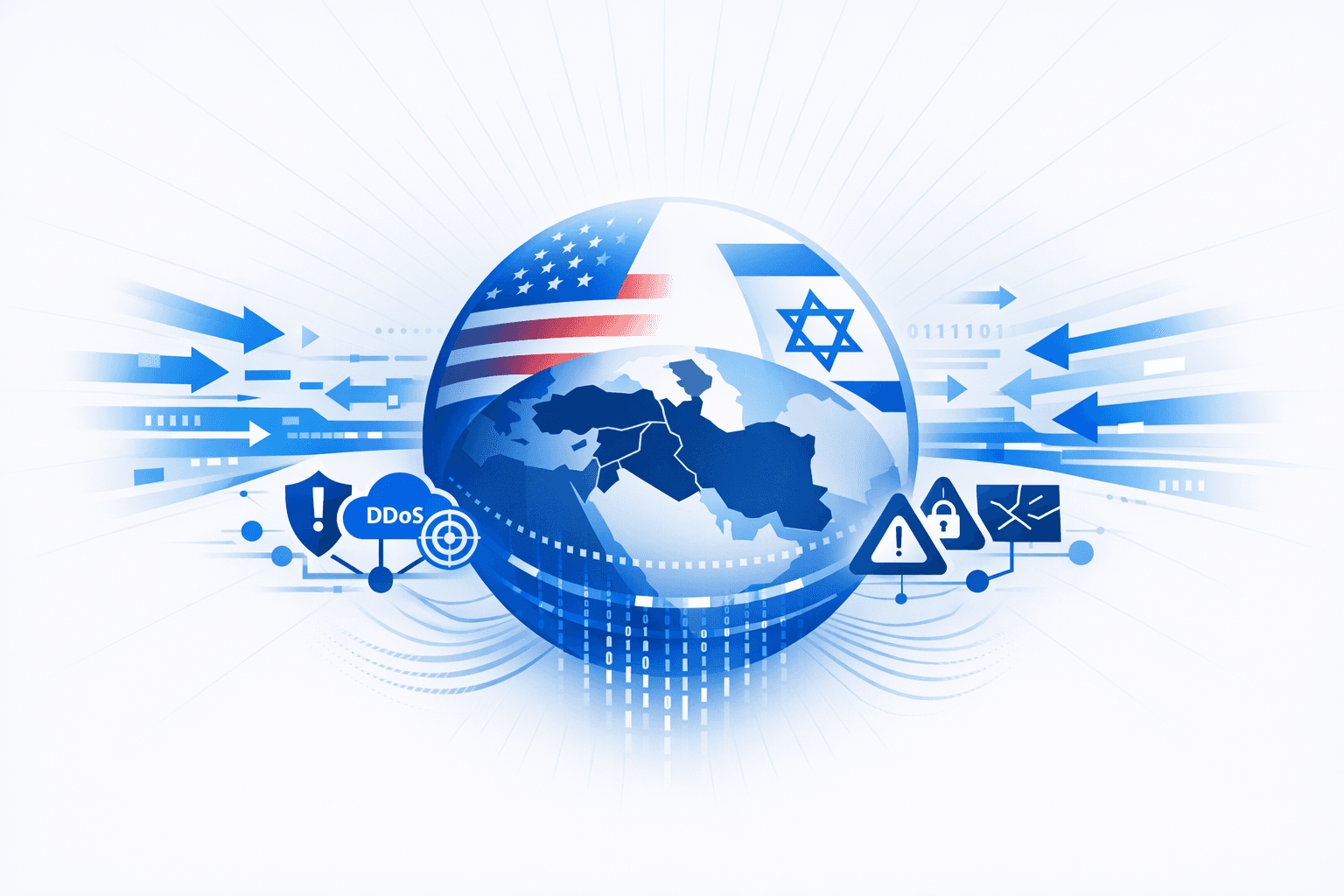
Cyber activity surged immediately following joint U.S.–Israel strikes on Iran (described as Operation Epic Fury), with reporting indicating a fast-moving “cyber swarm” of hacktivists and aligned collectives conducting disruption, influence messaging, and broad cyber claim activity within hours of the kinetic events. A day-by-day Telegram-focused timeline described early DDoS campaigns against Israeli government sites expanding into a wider coalition of pro-Iranian, pro-Palestinian, and Russian-aligned groups targeting additional regions and sectors, including Gulf states, Europe, and the U.S., with increasing attention on critical infrastructure; examples cited include claims of DDoS disruption against Israeli commercial, defense-adjacent, and energy-related entities (e.g., an oil company and an advanced defense firm), sometimes accompanied by third-party availability “verification” links.

U.S. state and local governments were separately warned by MS-ISAC to expect heightened “low-level” activity—particularly DDoS—in the wake of the Iran-related escalation, and were urged to harden internet-facing and cloud services (e.g., remediation of critical/cloud infrastructure, use of firewalls/CDNs, and reducing exposed employee/organizational data). In parallel, a critical-infrastructure-focused interview tied to an upcoming OT security summit reiterated that energy, water, pipeline, and ICS environments face persistent probing by state adversaries and that “low-cost entry” cyber operations can be used to test and disrupt mission-critical systems; while not specific to the Iran conflict, it reinforces the broader risk context for OT operators amid heightened geopolitical tensions.

Why it matters

Impact assessment

Cyber activity tied to the Iran-Israel-US conflict presents elevated disruption risk for government, critical infrastructure, cloud-dependent enterprises, and organizations with Middle East exposure. The most immediate impact is widespread low-to-moderate operational disruption from DDoS, defacement, leak claims, and influence operations, but reporting also indicates a credible risk of more serious follow-on intrusions against OT/ICS, supply chains, and enterprise environments.

Known activity is broad rather than narrowly targeted. Israel, Jordan, Kuwait, UAE, Saudi Arabia, Bahrain, Cyprus, Egypt, Denmark, Greenland, Europe, and U.S.-linked entities were all named in claims or reporting, with government, energy, water, telecom, finance, transportation, defense-adjacent, healthcare, and manufacturing sectors repeatedly referenced.

Severity and scope

  • Most publicly visible operations were described as DDoS, defacement, doxxing, reconnaissance, and exaggerated breach claims.
  • Multiple sources state many claims are unverified or inflated, but the volume of activity and targeting breadth are real.
  • MS-ISAC warned U.S. state and local governments to expect heightened low-level activity, especially DDoS.
  • Critical infrastructure operators face elevated concern because several groups explicitly referenced water, energy, PLCs, HMIs, and industrial systems.
  • Supply-chain intermediaries and contractors are at risk because reporting indicates some actors used stolen contractor data to create the appearance of direct compromise of larger energy firms.

Confirmed or plausibly real-world incidents

  • Jordan’s National Cybersecurity Center reportedly confirmed it thwarted an Iranian attack on its wheat silo management system on 2026-03-06.
  • Reporting states Handala claimed a destructive wipe at Stryker on 2026-03-12 via Microsoft Intune, with associated reports of global disruption and more than 5,000 workers in Ireland sent home.
  • Broadcom Symantec and Carbon Black reportedly identified MuddyWater activity in multiple U.S. networks in 2026, including an airport, a bank, and a software firm with ties to Israel.
  • Iranian drone strikes reportedly disrupted AWS facilities in the UAE and Bahrain, creating downstream cloud-service disruption across Gulf-dependent organizations.

Affected entities and sectors named in reporting

  • Government: Jordanian government infrastructure, Kuwaiti government domains, UAE government domains, Egyptian ministries, Israeli ministries
  • Critical infrastructure: water utilities, wheat silo management, fuel and energy entities, telecom, industrial pump HMIs
  • Finance: Bank Hapoalim, Bank Leumi, Mizrahi-Tefahot
  • Defense-adjacent: Rafael Advanced Defense Systems, Lockheed Martin claim, E.M.I.T. Aviation
  • Media and communications: i24 News, TCS Communications, Press TV
  • Healthcare: Stryker
  • Cloud and enterprise services: Microsoft cloud services, AWS regional facilities

Threat actors and ecosystems involved

  • Iran-aligned or proxy/hacktivist: Cyber Islamic Resistance Electronic Operations Room, 313 Team, Handala, CyberAv3ngers, Nation of Saviors, Liwaamohammad, APT IRAN, DieNet, Gaza Cyber Wolves, DarkStorm Team, Moroccan Black Cyber Army, RipperSec
  • Pro-Russian aligned: NoName057(16), RuskiNet, Z-Pentest Alliance, ServerKillers
  • Counter-hacktivist: Anonymous Syria Hackers, Anonymous Israel, Indian Cyber Force
Know this adversaryTTPs, infrastructure, and targeting history in one profile.
Get the profile
Event timeline

How this story unfolded

Events from the most recent confirmed update back to the earliest known activity.

9 events · Feb 1, 2026 – Mar 27, 2026
  1. Mar 27, 20268mo ago

    Iran-linked hackers threaten destructive attacks on U.S. water systems

    By 2026-03-27, major Iranian-linked hacker groups were reported to have coordinated public threats warning of 'irreparable damages' to U.S. water systems. The development marked a more explicit and focused escalation toward U.S. critical infrastructure beyond earlier general OT/ICS rhetoric.

    Major Iranian hackers unite, threaten ‘irreparable damages’ to U.S. water systems - Threat Beat
  2. Mar 10, 20269mo ago

    MS-ISAC warns U.S. state and local governments of possible Iran-linked intrusions

    On 2026-03-10, the Center for Internet Security's MS-ISAC warned U.S. state and local governments to expect heightened low-level cyber activity from Iran, including possible DDoS intrusions, following the conflict escalation. It urged rapid remediation of critical and cloud infrastructure, use of firewalls and CDNs, and reduction of publicly exposed organizational data.

  3. Mar 5, 20269mo ago

    Governments and industry issue warnings on Iran-related cyber risk

    By early March 2026, public warnings about elevated Iran-linked cyber threats were issued by authorities including the UK, Canada, Europol, and the U.S. Department of Homeland Security, alongside private-sector alerts. The advisories emphasized risks to government, critical infrastructure, cloud-dependent services, and organizations with Middle East exposure.

  4. Mar 2, 20269mo ago

    Hacktivist targeting expands across Middle East, Europe, and North America

    In the days following the initial strikes, Telegram-based hacktivist activity spread beyond Israel to targets in Kuwait, Jordan, Saudi Arabia, Qatar, Oman, Cyprus, the UK, and the U.S. Reported operations included DDoS attacks, defacements, hack-and-leak claims, and increasing rhetoric around OT/ICS targeting of water, energy, and food systems.

  5. Mar 1, 20269mo ago

    Jordan reportedly foils Iranian OT attack on wheat silo system

    A government-confirmed Iranian operational technology attack targeting Jordan's wheat silo management system was reportedly foiled during the early days of the conflict. The incident was cited as a notable example of attempted critical infrastructure targeting tied to the escalation.

  6. Mar 1, 20269mo ago

    Iranian drone strikes hit AWS facilities in UAE and Bahrain

    On 2026-03-01, reported Iranian drone strikes targeted three AWS facilities in the UAE and Bahrain, disrupting cloud-dependent services across the Gulf and beyond. The incident highlighted the conflict's spillover from cyber activity into attacks affecting digital infrastructure availability.

  7. Feb 28, 20269mo ago

    Iran's national internet reportedly drops to about 1% connectivity

    During the immediate aftermath of the strikes, Iran reportedly experienced a major internal internet disruption, with national connectivity falling to roughly 1% according to one source. Despite the outage, cyber operations and aligned online activity were said to continue via external infrastructure and proxy actors.

  8. Feb 28, 20269mo ago

    Iran-linked groups surge after joint U.S.-Israeli strikes on Iran

    Joint U.S.-Israeli strikes on Iran on 2026-02-28 were followed within hours by a sharp rise in cyber activity, including service disruptions, influence messaging, hacktivist mobilization, and numerous incident claims. Multiple sources describe this as the opening cyber escalation phase of the conflict.

  9. Feb 1, 202610mo ago

    MuddyWater reportedly pre-positions access in North American organizations

    Public reporting cited by multiple sources says MOIS-linked MuddyWater had been conducting pre-strike espionage and persistence activity since early February 2026, allegedly targeting organizations including a U.S. bank, a U.S. airport, a U.S./Canada nonprofit, and a software company operating in Israel. The activity reportedly involved previously undocumented backdoors including Dindoor and Fakeset.

Linked entities

Related entities

Vulnerabilities, threat actors, malware, products, organizations, breaches, and observables Mallory has linked to this story. Indicator values are masked here and available in full in the app.

Open in app →

Organizations

1 linked
Stryker

Observables

12 linked

Indicator values are masked on this page. View all 12 in Mallory Domains, IPs, hashes, and URLs are exportable to your SIEM.

Do you run this?See this adversary's TTPs, infrastructure, and targeting history, correlated against your exposure.
Get the Full Actor Profile
Mallory platform

See the full picture, correlated to your attack surface.

This page covers what’s public. Mallory adds the parts that aren’t: which of your assets are affected, which threat actors are using it right now, and what to deploy next.

Exposure mappingMap indicators from this story to your assets and identify affected systems in minutes.
Threat actor evidenceEvery observed campaign, victim, and pivot linked to actors named in this story.
Associated malwareMalware, exploits, and IOCs connected to the activity described here.
Detection signaturesYARA, Sigma, and Snort rules deployed to your SIEM as soon as they’re published.
Scheduled alertsGet matching new stories delivered to your team as they break, not the next morning.
AI threadsAsk questions about this story and take action on the answers.