Mallory
← Back to News
hacktivist-operationoperational-disruptiongovernment-diplomatic-threatstate-sponsored-disruption

Cyber Operations Escalate Following US-Israeli Strikes on Iran

Threat Actor Intelligence · 9 sources · Updated 5mo ago · First seen Mar 14, 2026
Cyber Operations Escalate Following US-Israeli Strikes on Iran

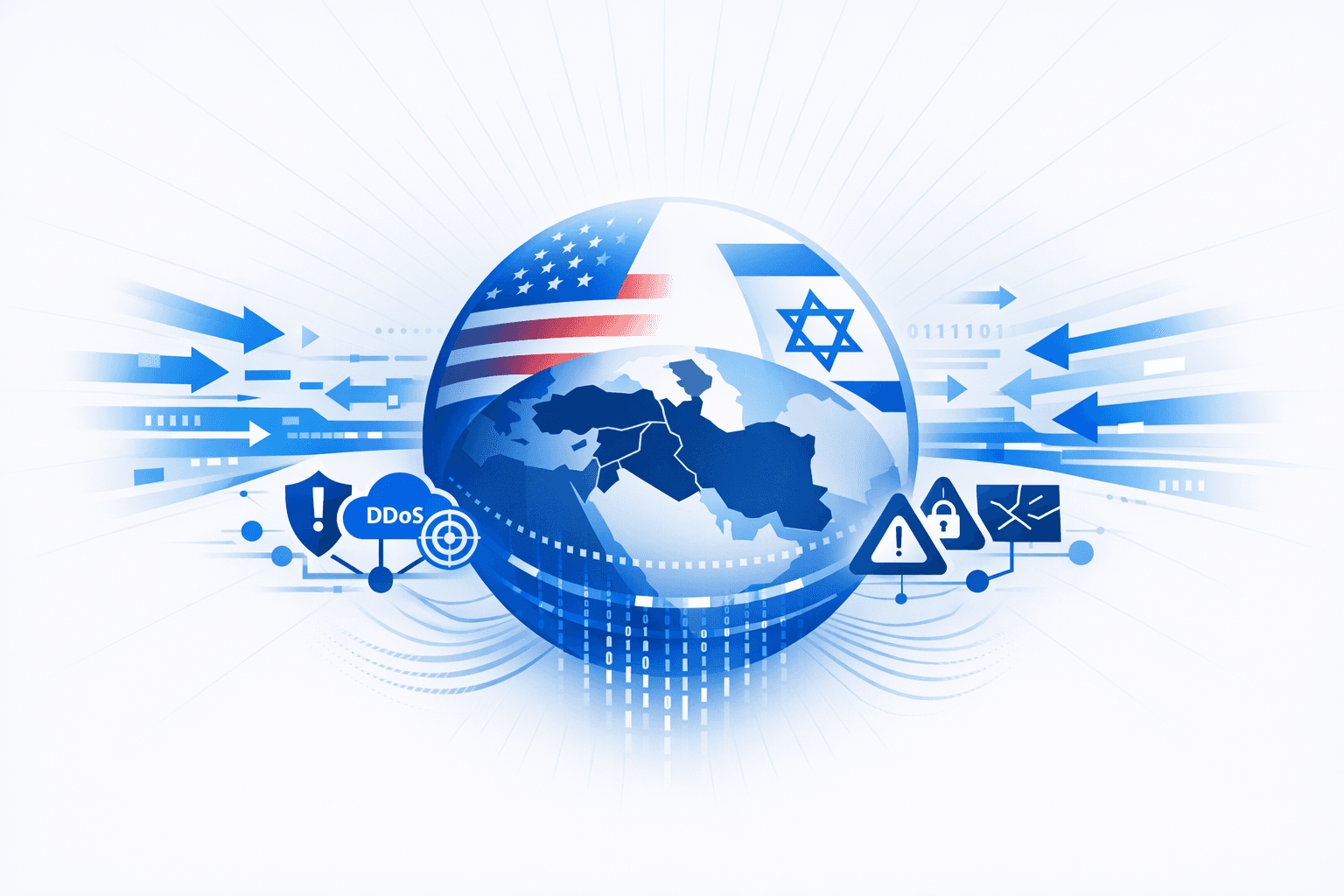
Military strikes by the United States and Israel against Iranian targets on February 28, 2026 were followed within hours by a sharp escalation in cyber activity across the Middle East. Reporting describes widespread DDoS attacks, website compromises, defacements, and breach claims, with more than 150 hacktivist incidents reportedly claimed in the first two days of the crisis. Iranian connectivity was heavily disrupted, including outages affecting IRNA, while Tasnim News was reportedly compromised and displayed anti-regime messaging. The most affected sectors were identified as government, aerospace and defense, and technology, and regional states including Israel, Kuwait, Jordan, Bahrain, Qatar, and the UAE saw elevated cyber pressure.

The surge also expanded beyond immediate regional targets, with security reporting warning that the conflict was driving attacks against global commercial sectors such as travel, hospitality, and energy. One cited example was a March 11 claim by Handala, a hacktivist group alleged to have ties to Iranian intelligence, that it had conducted a large-scale data-wiping attack against medical technology company Stryker, allegedly destroying several terabytes of data. Additional reporting noted unconfirmed concerns that Iranian-linked actors could target the physical and digital infrastructure of major U.S. technology firms. The activity reflects a broader pattern of geopolitically motivated cyber operations acting as a force multiplier alongside kinetic conflict, rather than a standalone marketing or advisory narrative.

Why it matters

Impact assessment

Cyber activity tied to the February 2026 Iran conflict is affecting government, defense, finance, telecom, aviation, healthcare, energy-adjacent, and cloud-dependent organizations across the Middle East and beyond. Impact ranges from high-volume disruption and defacement to destructive wiping, suspected OT/ICS targeting, and potential business interruption at global enterprises; the exposure is broad and multinational rather than narrowly targeted.

Known activity in the wild is extensive. Multiple sources report more than 150 hacktivist incidents in the first two days, 1,357 verified incidents in the first month across more than 25 countries, and a sharp rise in UAE breach attempts from roughly 90,000-200,000 per day to 600,000-800,000 per day after the strikes.

Business impact

  • Most affected sectors cited across reporting: government/public administration, aerospace and defense, financial services, technology, telecoms, aviation, law enforcement, healthcare, and energy-adjacent infrastructure.
  • Regional states under elevated pressure: Israel, Kuwait, Jordan, Bahrain, Qatar, UAE, Saudi Arabia, and Cyprus.
  • Global spillover sectors specifically noted: travel, hospitality, energy, and major U.S.-headquartered technology firms.
  • UAE cyber-relevant activity reportedly increased 15x normal volume; Saudi Arabia 25x; Qatar more than 4x.

Severity and scope

  • DDoS remains the dominant activity by volume, but reporting indicates a shift toward more serious intrusion, compromise, persistence, and destructive operations.
  • SOCRadar recorded 1,125 DDoS incidents out of 1,357 verified incidents, but also highlighted pre-positioned access, reconnaissance, geolocation doxxing, and destructive risk.
  • Government/public administration was the top targeted sector with 426 incidents; defense/aerospace had 116; financial services had 115.
  • Israel was the most targeted country with 516 incidents; Kuwait had 133; the U.S. had fewer incidents by volume but reportedly the highest-sophistication confirmed operations.

Confirmed or claimed incidents

  • IRNA outages and compromise of Tasnim News with anti-regime messaging were reported during the opening phase.
  • A prayer/religious application in Iran was compromised to push political messaging.
  • Handala claimed a destructive attack on Stryker on March 11-12, including remote wiping via Microsoft Intune; SOCRadar states more than 200,000 devices across operations in 79 countries were wiped, and Stryker filed an SEC 8-K confirming the incident.
  • More than 5,000 workers were reportedly sent home from Stryker’s Ireland hub after the disruption.
  • Jordan’s National Cybersecurity Center reportedly thwarted an Iran-linked attack on grain storage infrastructure.
  • Reporting cites pre-positioned MuddyWater implants in a U.S. bank, an airport, a defense-adjacent software company, and NGOs.

Confidence notes

  • Several OT/ICS compromise claims, cloud infrastructure damage claims, and some breach assertions remain unverified in the provided reporting.
  • Despite the surge, CypherLeak reported little evidence of successful destructive attacks against UAE critical infrastructure, suggesting improved regional defensive maturity is reducing realized impact.
Know this adversaryTTPs, infrastructure, and targeting history in one profile.
Get the profile
Event timeline

How this story unfolded

Events from the most recent confirmed update back to the earliest known activity.

10 events · Feb 28, 2026 – Apr 17, 2026
  1. Apr 17, 20268mo ago

    SOCRadar says conflict enters persistence and reconnaissance phase

    By April 17, 2026, SOCRadar reported 1,357 verified cyber incidents in the first month of the Iran war across more than 25 countries, 15 sectors, and over 40 threat groups. The firm assessed that the campaign had moved beyond overt disruption into a quieter phase marked by reconnaissance, pre-positioned access, and latent destructive risk if the ceasefire breaks down.

    Iran War Cyber Threat Outlook: Conflict Phases and What Comes Next
  2. Mar 25, 20268mo ago

    Underground markets offer allegedly authentic stolen Iranian datasets

    By March 25, 2026, ZenoX reported underground sales of allegedly stolen Iranian banking, civil, health, exchange, and business datasets linked to the conflict. The company said reviewed sample data appeared likely authentic, indicating monetization of compromised Iranian information beyond disruptive attacks.

    Threat Intelligence: How Cybercrime Behaves in Geopolitical Conflict Scenarios - ZenoX - Artificial Intelligence for Cyber Security
  3. Mar 12, 20269mo ago

    Stryker disruption reported as week-two escalation

    On March 12, 2026, reporting described disruption at Stryker as a key second-week development in the conflict. The incident was framed as retaliation by Handala and as evidence of escalation toward more destructive operations.

  4. Mar 11, 20269mo ago

    Handala claims large-scale data-wiping attack on Stryker

    On March 11, 2026, the hacktivist group Handala claimed it had carried out a destructive data-wiping attack against Stryker. The claim said several terabytes of critical data were destroyed, and later reporting characterized the incident as a shift toward wiper-style attacks on a global enterprise.

  5. Mar 3, 20269mo ago

    Regional cybercrime and proxy activity broadens beyond state actors

    By early March, reporting highlighted additional opportunistic activity tied to the conflict, including vishing scams in the UAE, ransomware extortion against an Israeli industrial machinery company, and intimidation campaigns by Handala Hack against Iranian-American and Iranian-Canadian influencers. This showed the conflict drawing in cybercriminal and proxy actors beyond traditional state-linked operations.

  6. Mar 3, 20269mo ago

    Malicious fake RedAlert app used in phishing campaign

    Unit 42 identified an active phishing campaign using a malicious replica of Israel's Home Front Command RedAlert Android application. The app was designed to deliver mobile surveillance and data-exfiltration malware to targets.

  7. Mar 3, 20269mo ago

    Internet connectivity inside Iran drops to 1-4%

    Severe internet disruption inside Iran reduced national connectivity to roughly 1-4%, according to Unit 42. The disruption was assessed as likely constraining the ability of Iran-based state-aligned actors to coordinate sophisticated cyber operations in the near term.

  8. Mar 1, 20269mo ago

    More than 150 cyber incidents claimed in first two days

    Within the first 48 hours of the conflict, more than 150 cyber incidents were reportedly claimed by participating groups. The activity reflected a rapid surge in disruptive operations against government, finance, telecom, aviation, and critical infrastructure targets.

  9. Feb 28, 20269mo ago

    Retaliatory cyber campaign expands across the Middle East

    Following the February 28 strikes, Iran-aligned actors and hacktivist/proxy groups began a multi-vector retaliatory cyber campaign. Reports describe DDoS attacks, hack-and-leak activity, destructive operations, and intrusions affecting targets in Israel and other regional states.

  10. Feb 28, 20269mo ago

    U.S. and Israel launch joint military operations against Iran

    On February 28, 2026, the United States and Israel began joint military operations against Iran. Multiple sources describe this as the trigger for a broader cyber escalation tied to the conflict.

Linked entities

Related entities

Vulnerabilities, threat actors, malware, products, organizations, breaches, and observables Mallory has linked to this story. Indicator values are masked here and available in full in the app.

Open in app →

Affected products

1 linked
Amazon Web Services

Organizations

3 linked
Amazon Web ServicesSaudi AramcoStryker

Breaches

1 linked
STRYKER-2026-04

Observables

125 linked

Indicator values are masked on this page. View all 125 in Mallory Domains, IPs, hashes, and URLs are exportable to your SIEM.

Do you run this?See this adversary's TTPs, infrastructure, and targeting history, correlated against your exposure.
Get the Full Actor Profile
Mallory platform

See the full picture, correlated to your attack surface.

This page covers what’s public. Mallory adds the parts that aren’t: which of your assets are affected, which threat actors are using it right now, and what to deploy next.

Exposure mappingMap indicators from this story to your assets and identify affected systems in minutes.
Threat actor evidenceEvery observed campaign, victim, and pivot linked to actors named in this story.
Associated malwareMalware, exploits, and IOCs connected to the activity described here.
Detection signaturesYARA, Sigma, and Snort rules deployed to your SIEM as soon as they’re published.
Scheduled alertsGet matching new stories delivered to your team as they break, not the next morning.
AI threadsAsk questions about this story and take action on the answers.