Spearphishing Campaigns Abuse PDF and Windows Screensaver Files to Install Legitimate RMM Tools
Social Engineering & Fraud · 3 sources · Updated 5mo ago · First seen Feb 6, 2026
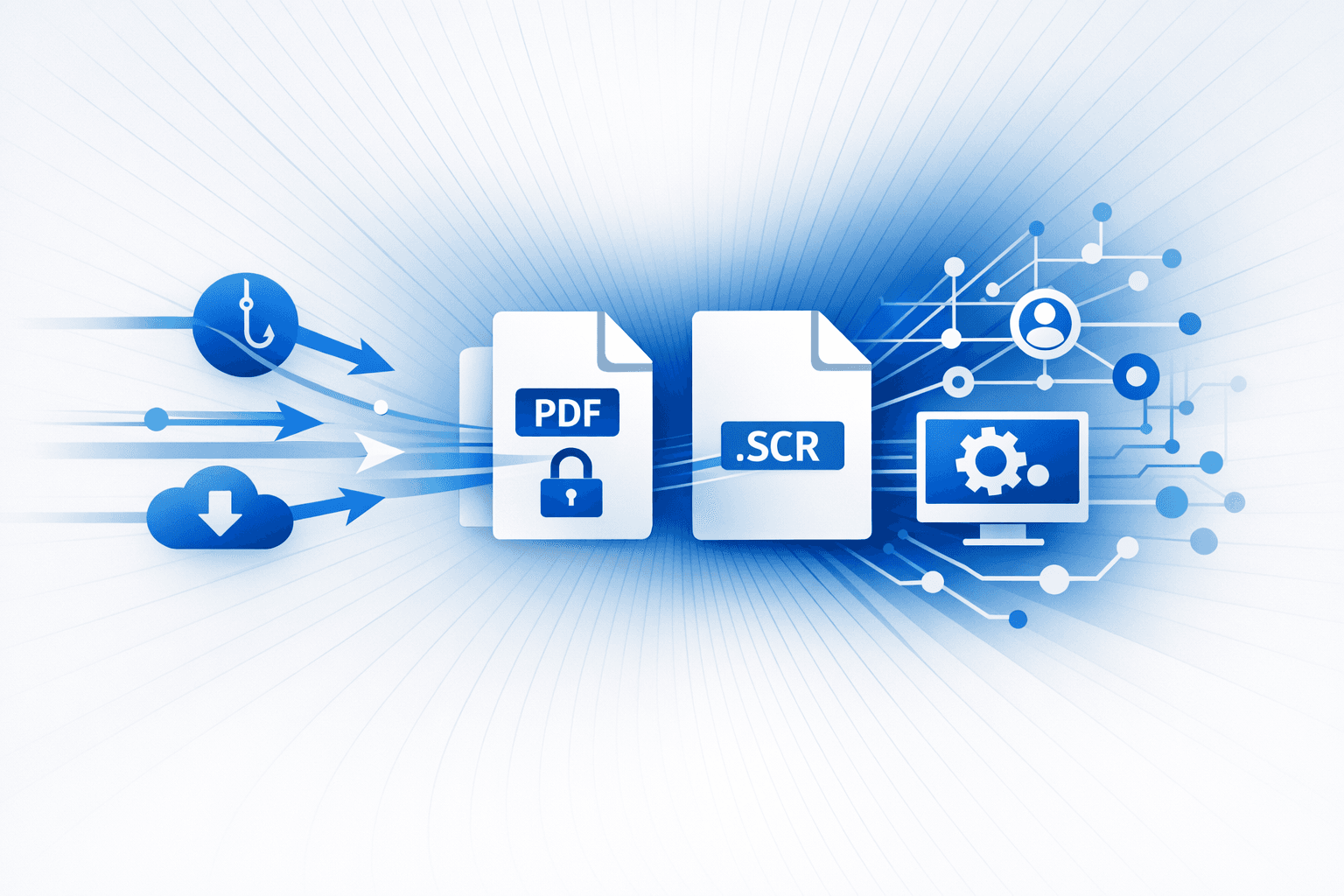
Threat actors have been observed using spearphishing lures and non-traditional attachment types—particularly Windows screensaver (.scr) executables—to trick users into running code that silently installs legitimate remote monitoring and management (RMM) agents (e.g., SimpleHelp). ReliaQuest research described business-themed filenames (e.g., InvoiceDetails.scr, ProjectSummary.scr) delivered via links hosted on legitimate cloud services (e.g., GoFile), with the .scr format helping bypass controls that don’t treat screensavers as executables. Once installed, the RMM tooling provides interactive remote access that can enable data theft, lateral movement, and follow-on payload deployment, including ransomware, while blending into normal IT administration traffic.
Separately, researchers also reported a spam operation using fake PDF attachments that display an error message and redirect victims to a lookalike Adobe Acrobat download flow, but instead installs trusted, digitally signed RMM software to establish persistent access. A different phishing campaign used a multi-stage PDF chain hosted on reputable infrastructure (e.g., Vercel Blob) to redirect victims to a credential-harvesting page and exfiltrate stolen data via a Telegram bot, emphasizing how attackers are increasingly abusing high-reputation cloud platforms and document-based lures to evade email and web filtering (including scenarios where the initial email contains no malicious link and can pass SPF/DKIM/DMARC checks).
Why it matters
Impact assessment
This activity affects organizations that rely on email-based business workflows and Windows endpoints, especially environments where uncommon executable types such as .scr are not controlled as strictly as .exe. The immediate impact is unauthorized remote access through legitimate RMM software, which can support credential theft, data exfiltration, lateral movement, and ransomware deployment while blending into normal administrative traffic.
The scope appears broader than a single targeted intrusion because ReliaQuest observed the .scr-based campaign across multiple customers, and the tradecraft uses common cloud-hosted delivery and trusted tooling that can scale easily. There is confirmed malicious use in the wild of spearphishing, fake PDF lures, and cloud-hosted redirect chains, although no specific actor attribution was established in the referenced reporting.
Affected populations
- Windows users targeted by business-themed phishing emails
- Organizations that permit execution of
.scrfiles or do not classify them as executables in policy - Enterprises that allow unsanctioned RMM tools or lack RMM allowlisting
- Security teams that rely heavily on reputation-based filtering for cloud-hosted links and attachments
Severity and business risk
- High risk of persistent unauthorized remote access
- Elevated risk of data theft and credential compromise
- Potential for operational disruption through lateral movement and ransomware follow-on activity
- Reputational and financial impact if attackers use trusted admin tooling to evade detection and maintain access
Scope and exposure facts
- ReliaQuest reported the
.scrcampaign across multiple customers - Delivery used legitimate cloud/file-hosting services including GoFile and reputable infrastructure such as Vercel Blob
- Fake PDF workflows and no-link initial emails can reduce effectiveness of standard email filtering, including cases that pass SPF/DKIM/DMARC
- Prior related abuse of
.scrfiles was reported in August 2025 to deploy GodRAT against financial institutions