Mallory
← Back to News
privacy-surveillance-policycybersecurity-regulationtelecommunications-sector-threat

Russia Expands Internet Controls, Raising Surveillance and Business Disruption Risks

Regulatory & Policy · 2 sources · Updated 1mo ago · First seen Oct 15, 2026
Russia Expands Internet Controls, Raising Surveillance and Business Disruption Risks

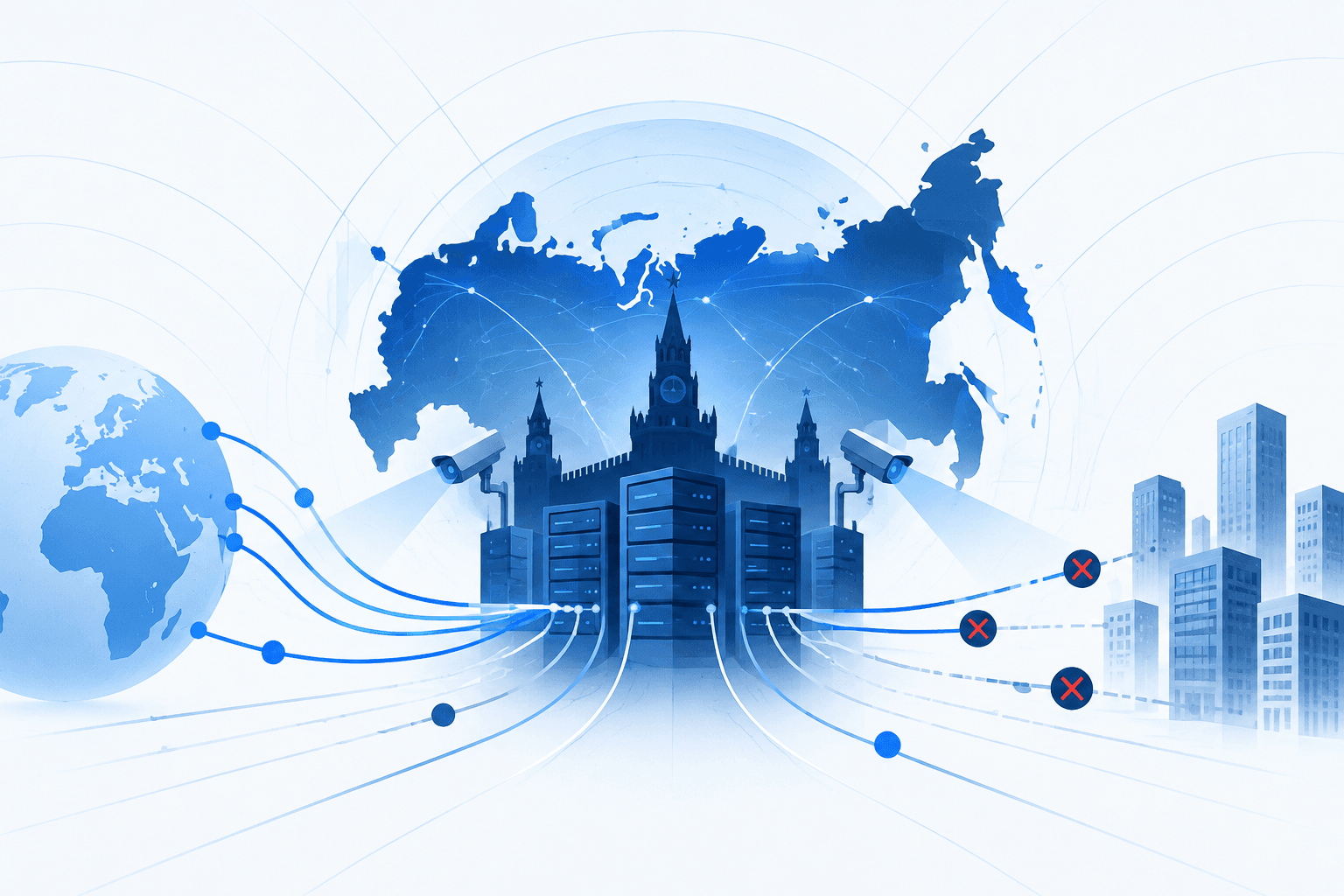
Russia has intensified restrictions on communications platforms, VPNs and internet infrastructure since mid-2025, increasing surveillance and operational risks for organizations with Russian exposure. Recorded Future’s Insikt Group assesses that Moscow aims to maintain global connectivity while gaining the ability to isolate Russia’s internet when desired. The measures build on data-localization requirements, communications-retention laws and state-controlled traffic filtering. Managed shutdowns are very likely testing isolation capabilities, while expanded shutdown powers and provisions to preserve essential services help limit public backlash. Technical and political constraints nevertheless make a fully sovereign internet unlikely in the near term.

Insikt Group expects authorities to prioritize platform-enforced VPN blocking and financial or practical deterrents over an immediate blanket ban on individual VPN use. Passive surveillance through Russia’s SORM interception system remains the primary near-term concern, particularly for traffic without end-to-end encryption; traffic injection through in-path TSPU filtering infrastructure is technically possible but assessed as an unlikely escalation. Amnezia VPN attributed disruptive June 2026 DDoS attacks to Roskomnadzor, but the report did not independently establish that attribution. Organizations should assess sensitive-data exposure, resilience to communications and business-application outages, and legal, supply-chain and sanctions risks associated with Russian operations.

Why it matters

Russia’s expanding internet controls expose organizations, employees, and suppliers operating in or communicating through Russia to state surveillance and recurring communications outages. The exposure is nationwide rather than sector-specific, with potential consequences including sensitive-data disclosure, unavailable business applications, disrupted payments and emergency communications, and legal or sanctions-related losses. Insikt Group identifies passive surveillance as the primary near-term threat; nationwide internet isolation and offensive traffic injection are assessed possibilities, not established current outcomes.

  • Direct exposure: Russian offices, locally hosted personal data, mobile-dependent operations, and services relying on blocked platforms or VPN connectivity.
  • Indirect exposure: International organizations dependent on Russian suppliers, personnel, telecommunications, or digital services.
  • Observed disruption: Regular mobile internet outages and platform/VPN restrictions have occurred since mid-2025. Historical large-scale blocking also disrupted unrelated banking and retail infrastructure.
  • Attribution limit: Amnezia VPN attributed June 2026 DDoS disruptions to Roskomnadzor; Insikt Group did not independently establish that attribution.
What this changes for youSee the reporting duties and controls this puts on the clock.
Get the context
Event timeline

How this story unfolded

Events from the most recent confirmed update back to the earliest known activity.

35 events · 2008 – Jun 2026
  1. Reported Oct 15, 20261mo ago

    Russia's VPN advertising ban takes effect

    Law No. 406-FZ prohibited advertising VPNs and other tools used to circumvent website and platform restrictions.

    Russia Is Tightening Internet Controls, Leading to Operational Risks - Malware Analysis - Malware Analysis, News and Indicators
  2. Reported Oct 15, 20261mo ago

    Roskomnadzor begins protocol-level blocking of VPN services

    During 2023–2024, Roskomnadzor began using deep packet inspection hardware to block VPN protocols including OpenVPN, WireGuard, and Shadowsocks.

    Russia Is Tightening Internet Controls, Leading to Operational Risks - Malware Analysis - Malware Analysis, News and Indicators
  3. Reported Oct 15, 20261mo ago

    Russia blocks hundreds of independent news outlets following its invasion

    Following Russia's full-scale invasion of Ukraine, the Kremlin blocked hundreds of independent outlets, including Meduza, BBC, Radio Free Europe, and Ekho Moskvy. Authorities distributed DNS- and Server Name Indication-level blocks to TSPU devices across Russian ISPs.

    Russia Is Tightening Internet Controls, Leading to Operational Risks - Malware Analysis - Malware Analysis, News and Indicators
  4. Reported Oct 15, 20261mo ago

    Kremlin facilitates transfer of VKontakte to state-aligned interests

    The Kremlin facilitated the transfer of VKontakte to state-aligned business interests, strengthening state influence over the platform.

    Russia Is Tightening Internet Controls, Leading to Operational Risks - Malware Analysis - Malware Analysis, News and Indicators
  5. Reported Oct 15, 20261mo ago

    Digital development ministry adds online voting resources to an allowlist

    Russia's Ministry of Digital Development said online voting resources had been added to an allowlist so they could remain available during mobile and internet restrictions.

    Russia Is Tightening Internet Controls, Leading to Operational Risks
  6. Reported Oct 15, 20261mo ago

    Officials cite election interference as grounds for internet disruptions

    Central Election Commission Chair Ella Pamfilova and State Duma official Alexei Chepa cited security threats and potential online election interference as possible grounds for internet disruptions around the September 2026 elections.

    Russia Is Tightening Internet Controls, Leading to Operational Risks
  7. Reported Oct 15, 20261mo ago

    Russian ministries publicly portray VPNs as privacy and data-theft risks

    Russia's Ministry of Digital Development and Ministry of Internal Affairs issued statements portraying VPN services as risks to privacy and potential sources of data theft.

    Russia Is Tightening Internet Controls, Leading to Operational Risks
  8. Reported Oct 15, 20261mo ago

    Peskov presents Roblox reinstatement as a model for blocked platforms

    Kremlin spokesperson Dmitry Peskov presented Roblox's reinstatement as evidence that blocked services could return if they complied with Russian law.

    Russia Is Tightening Internet Controls, Leading to Operational Risks
  9. Reported Oct 15, 20261mo ago

    Automated VPN-fining proposal is rejected

    The proposal to identify VPN users through SIM cards and automatically issue fines through Gosuslugi was subsequently rejected.

    Russia Is Tightening Internet Controls, Leading to Operational Risks
  10. Reported Oct 15, 20261mo ago

    Major Russian operators block mobile-account top-ups of Apple ID balances

    Russia's four major telecommunications operators reportedly blocked Apple ID balance top-ups from mobile accounts, ostensibly to prevent purchases of VPN applications. The restrictions were reported as already in place by April 1, 2026.

    Russia Is Tightening Internet Controls, Leading to Operational Risks
  11. Jun 2026

    Amnezia VPN attributes disruptive DDoS attacks to Roskomnadzor

    Amnezia VPN blamed Roskomnadzor for large-scale DDoS attacks that disrupted connectivity. Insikt Group did not independently establish that attribution and reported identifying no further attacks.

    Russia Is Tightening Internet Controls, Leading to Operational Risks
  12. Jun 2026

    Russia unblocks Roblox following reported compliance commitments

    Russia restored access to Roblox following reported commitments to comply with Russian legislation on user safety and objectionable content.

    Russia Is Tightening Internet Controls, Leading to Operational Risks
  13. May 2026

    Putin orders preservation of essential services during connectivity restrictions

    Putin directed Prime Minister Mikhail Mishustin and FSB Director Alexander Bortnikov to preserve essential public, medical, and payment services during internet and telecommunications restrictions.

    Russia Is Tightening Internet Controls, Leading to Operational Risks
  14. Apr 2026

    The Bell reports FSB proposal for automated fines against VPN users

    The Bell reported that FSB officials proposed automatically fining VPN users through Gosuslugi based on SIM-card identification.

    Russia Is Tightening Internet Controls, Leading to Operational Risks
  15. Mar 2026

    Antimonopoly service announces Telegram and YouTube advertising grace period

    Russia's Federal Anti-Monopoly Service announced a grace period through the end of 2026 for an advertising ban affecting Telegram and YouTube. The agency linked the ban to Roskomnadzor's access restrictions.

    Russia Is Tightening Internet Controls, Leading to Operational Risks
  16. Mar 2026

    Proposal seeks surcharges on high-volume international mobile traffic

    A proposal would have required mobile operators to charge 150 rubles per gigabyte for international traffic exceeding 15 GB per month, potentially increasing the cost of sustained VPN use.

    Russia Is Tightening Internet Controls, Leading to Operational Risks
  17. Mar 2026

    Kommersant reports accreditation threats against developers allowing VPN access

    Kommersant reported that Russian developers allowing VPN users to access their services risked losing IT accreditation, associated tax and employee military-deferment benefits, and application preinstallation rights.

    Russia Is Tightening Internet Controls, Leading to Operational Risks
  18. Mar 2026

    Digital development minister says VPN-user fines are under consideration

    Digital Development Minister Maksut Shadayev said administrative fines for VPN use were being considered, while describing them as an undesirable blunt solution.

    Russia Is Tightening Internet Controls, Leading to Operational Risks
  19. Dec 2025

    Russia blocks Roblox

    Russia blocked access to Roblox, preceding negotiations over compliance with Russian legislation on user safety and objectionable content.

    Russia Is Tightening Internet Controls, Leading to Operational Risks
  20. Oct 2025

    Decree grants Russian agencies broad internet-disconnection powers

    A decree granted Roskomnadzor, the FSB, and the Ministry of Digital Development broad authority to disconnect the Russian internet in response to threats to its stability, security, or integrity.

    Russia Is Tightening Internet Controls, Leading to Operational Risks
  21. Jul 2025

    Kremlin intensifies communications restrictions and mobile internet outages

    Beginning in July 2025, the Kremlin tightened access to civilian communications applications and VPNs, caused regular mobile internet outages, and introduced requirements increasing surveillance of Russian and foreign individuals and firms.

    Russia Is Tightening Internet Controls, Leading to Operational Risks - Malware Analysis - Malware Analysis, News and Indicators
  22. 2024

    Perviy Otdel reports FSB spyware installation on a detained analyst's phone

    Legal rights group Perviy Otdel reported that the FSB installed Monokle spyware on systems analyst Kirill Parubets's phone following his detention for donating to Ukrainian organizations. Citizen Lab assessed that the software was likely an upgraded Monokle variant or new software reusing its code.

    Russia Is Tightening Internet Controls, Leading to Operational Risks
  23. 2024

    Roskomnadzor begins severely throttling YouTube

    Roskomnadzor began throttling YouTube to near-unusable levels.

    Russia Is Tightening Internet Controls, Leading to Operational Risks - Malware Analysis - Malware Analysis, News and Indicators
  24. Mar 2022

    Russia fully blocks Facebook and Instagram after throttling them

    The Kremlin fully blocked access to Facebook and Instagram after using TSPU packet dropping to throttle the platforms.

    Russia Is Tightening Internet Controls, Leading to Operational Risks - Malware Analysis - Malware Analysis, News and Indicators
  25. 2022

    Study documents pervasive TSPU deployment across residential networks

    A study found Russia's TSPU filtering hardware positioned in the traffic path of more than one million measured endpoints across residential networks.

    Russia Is Tightening Internet Controls, Leading to Operational Risks
  26. 2021

    Kremlin deploys TSPU at scale to throttle a mainstream social platform

    The Kremlin conducted its first large-scale deployment of TSPU deep packet inspection hardware to throttle a mainstream social media platform.

    Russia Is Tightening Internet Controls, Leading to Operational Risks - Malware Analysis - Malware Analysis, News and Indicators
  27. 2019

    Sovereign Internet Law mandates state-controlled traffic-filtering equipment

    Law No. 90-FZ required Russian ISPs to install Roskomnadzor-controlled TSPU equipment, enabling the state to throttle or sever external traffic to platforms.

    Russia Is Tightening Internet Controls, Leading to Operational Risks - Malware Analysis - Malware Analysis, News and Indicators
  28. 2018

    Telegram blocking attempt disrupts Russian banking and retail systems

    Roskomnadzor attempted to block Telegram by banning the IP addresses of millions of cloud servers. The operation disrupted banking and retail systems without successfully shutting down Telegram.

    Russia Is Tightening Internet Controls, Leading to Operational Risks - Malware Analysis - Malware Analysis, News and Indicators
  29. 2017

    Anonymizers Law prohibits VPN-based circumvention

    Law No. 276-FZ formally prohibited using VPNs to circumvent blocked websites.

    Russia Is Tightening Internet Controls, Leading to Operational Risks - Malware Analysis - Malware Analysis, News and Indicators
  30. 2016

    Yarovaya laws expand communications retention and security-service access

    Laws No. 374-FZ and No. 375-FZ required communications providers to retain metadata for up to three years and message and audio content for six months. Russian security services received warrantless access.

    Russia Is Tightening Internet Controls, Leading to Operational Risks - Malware Analysis - Malware Analysis, News and Indicators
  31. 2014

    Data Localization Law mandates domestic storage of Russians' personal data

    Law No. 242-FZ required foreign internet companies to store Russian citizens' personal data on physical servers inside Russia.

    Russia Is Tightening Internet Controls, Leading to Operational Risks - Malware Analysis - Malware Analysis, News and Indicators
  32. 2014

    Pavel Durov is forced out of Russia after refusing FSB data demands

    VKontakte founder Pavel Durov was forced out of Russia after refusing to provide data to the Federal Security Service.

    Russia Is Tightening Internet Controls, Leading to Operational Risks - Malware Analysis - Malware Analysis, News and Indicators
  33. 2014

    Lugovoy Law enables extrajudicial website blocking

    Law No. 398-FZ enabled extrajudicial blocking of websites deemed extremist or associated with calls for unauthorized protests.

    Russia Is Tightening Internet Controls, Leading to Operational Risks - Malware Analysis - Malware Analysis, News and Indicators
  34. 2012

    Law No. 139-FZ creates Russia's banned-websites register

    The law created the Unified Register of Banned Websites and introduced ISP-level blocking infrastructure using DNS tampering to restrict domains and IP addresses.

    Russia Is Tightening Internet Controls, Leading to Operational Risks - Malware Analysis - Malware Analysis, News and Indicators
  35. 2008

    Russia establishes Roskomnadzor

    Russia established Roskomnadzor, initially focusing primarily on telecommunications licensing rather than censorship or content filtering.

    Russia Is Tightening Internet Controls, Leading to Operational Risks - Malware Analysis - Malware Analysis, News and Indicators
Linked entities

Related entities

Vulnerabilities, threat actors, malware, products, organizations, and breaches Mallory has linked to this story.

Open in app →

Affected products

1 linked
Telegram

Organizations

16 linked
Federal Security Service of the Russian FederationMeta PlatformsBritish Broadcasting CorporationAppleTelegramRoblox CorporationVKGovernment of the Russian FederationMeduzaRadio Free Europe/Radio Liberty+6 more
Do you run this?See what this changes for your reporting obligations and which controls it puts on the clock.
Get the Regulatory Context
Mallory platform

See the full picture, correlated to your attack surface.

This page covers what’s public. Mallory adds the parts that aren’t: which of your assets are affected, which threat actors are using it right now, and what to deploy next.

Exposure mappingMap indicators from this story to your assets and identify affected systems in minutes.
Threat actor evidenceEvery observed campaign, victim, and pivot linked to actors named in this story.
Associated malwareMalware, exploits, and IOCs connected to the activity described here.
Detection signaturesYARA, Sigma, and Snort rules deployed to your SIEM as soon as they’re published.
Scheduled alertsGet matching new stories delivered to your team as they break, not the next morning.
AI threadsAsk questions about this story and take action on the answers.