
Loading story…
North Korea-linked Kimsuky continued spear-phishing operations built around the AppleSeed malware family, delivering payloads through JavaScript droppers, Excel macros, and malicious OneNote files disguised as business documents, surveys, purchase orders, and request forms. Researchers tied the activity to targeted campaigns against South Korean organizations as well as scientific and engineering researchers, with lures impersonating trusted institutions and decoy documents used to trigger hidden scripts. In multiple cases, the malware was launched through regsvr32.exe, fetched follow-on components with mshta.exe, and shifted persistence and installation patterns from %PROGRAMDATA% toward %APPDATA%, while adding anti-analysis checks to evade defenders.
The group also introduced AlphaSeed, a Golang-based evolution of AppleSeed that uses embedded Naver Mail cookies and the Chrome DevTools Protocol for command-and-control instead of older mailbox authentication methods. AlphaSeed was reported to persist via the Windows Run key as MS_SecSvc, collect keystrokes and screenshots, encrypt stolen data with RC4 and RSA, and exfiltrate data through Naver Mail. Across the broader intrusion chain, Kimsuky was observed using post-compromise tools including Meterpreter, TightVNC, and TinyNuke-derived HVNC, while increasingly favoring Chrome Remote Desktop over RDP; researchers also documented multi-platform artifacts, mobile AppleSeed-related components, server-side scripts, and operational links connecting these campaigns to earlier Kimsuky activity.

TTPs, infrastructure, and targeting history in one profile.
15 events from the most recent confirmed update back to the earliest known activity.
S2W Talon discovered a suspected new Kimsuky malware sample on VirusTotal on May 6, 2023, and named it AlphaSeed based on an internal path string found in the binary.
S2W reported a Kimsuky campaign using a malicious Microsoft OneNote file impersonating Korea University's Institute for Peace and Democracy to deliver malware via a hidden VBS script.
AhnLab reports that a Golang-based Meterpreter stager was identified in the first half of 2023 as part of Kimsuky attack chains involving AppleSeed.
AhnLab states that the Golang-based AlphaSeed variant has been used in attacks since at least October 2022 and can be deployed alongside AppleSeed on the same target.
ASEC disclosed an AppleSeed campaign targeting companies related to nuclear power plants, using VBS droppers with double extensions disguised as purchase orders or request forms and opening a benign Excel bait file. The report detailed regsvr32-based DLL execution, C2 communications with ndt.info[.]gf, supported backdoor commands, and related IOCs.
ASEC disclosed signs of an AppleSeed distribution campaign targeting a specific military unit maintenance contractor using a password-protected Excel lure with a military-themed filename. The macro used mshta to fetch additional scripts that downloaded AppleSeed and executed it via regsvr32, and the report published related hashes and C2 URLs.
AhnLab reports that since early 2022, AppleSeed has been created by a dropper rather than being installed directly by JavaScript malware.
ASEC analyzed a confirmed spear-phishing attack in which a ZIP-delivered .pif dropper installed the PebbleDash backdoor, displayed a decoy PDF, and gave attackers remote control of the infected system. The report also linked related AppleSeed, VBS downloader, and Meterpreter activity to the same intrusion set and published persistence details, hashes, and C2 IOCs.
At VB2021, researchers presented "Operation Newton," an investigation reconstructing the full AppleSeed attack chain used by Kimsuky against scientific and engineering researchers, including infrastructure and multi-platform artifacts.
The VB2021 localhost content states that details about AppleSeed were previously presented at VB2019 during tracking of ongoing Kimsuky attacks.
Since 2017, Kimsuky attacks have also targeted countries beyond South Korea, broadening the group's victim geography.
AhnLab states that Kimsuky attacked a South Korean energy corporation in 2014, marking an early significant victim in the group's activity.
The North Korea-linked Kimsuky group is described as having been active since 2013, initially targeting North Korea-related research institutes in South Korea.
AhnLab published trend analysis showing Kimsuky continuing AppleSeed campaigns while adding anti-analysis argument checks, shifting installations toward %APPDATA%, introducing AlphaSeed, and increasingly using Chrome Remote Desktop for remote control.
ASEC disclosed a campaign distributing AppleSeed through JSE files masquerading as purchase orders and request forms, with execution via regsvr32 and follow-on scripts via mshta.
Vulnerabilities, threat actors, malware, products, organizations, breaches, and observables Mallory has linked to this story. Indicator values are masked here and available in full in the app.
Indicator values are masked on this page. View all 55 in Mallory Domains, IPs, hashes, and URLs are exportable to your SIEM.
See this adversary's TTPs, infrastructure, and targeting history, correlated against your exposure.
8 references tracked. Mallory keeps watching after this page renders.
asec.ahnlab.com
Open sourcemedium.com
Open sourcemedium.com
Open sourceasec.ahnlab.com
Open sourceasec.ahnlab.com
Open sourceasec.ahnlab.com
Open sourceasec.ahnlab.com
Open sourcevblocalhost.com
Open sourceMap indicators from this story to your assets and identify affected systems in minutes.
Every observed campaign, victim, and pivot linked to actors named in this story.
Malware, exploits, and IOCs connected to the activity described here.
YARA, Sigma, and Snort rules deployed to your SIEM as soon as they’re published.
Get matching new stories delivered to your team as they break — not the next morning.
Ask questions about this story and take action on the answers.
Other stories Mallory is tracking that overlap on entities, sources, or topic labels.
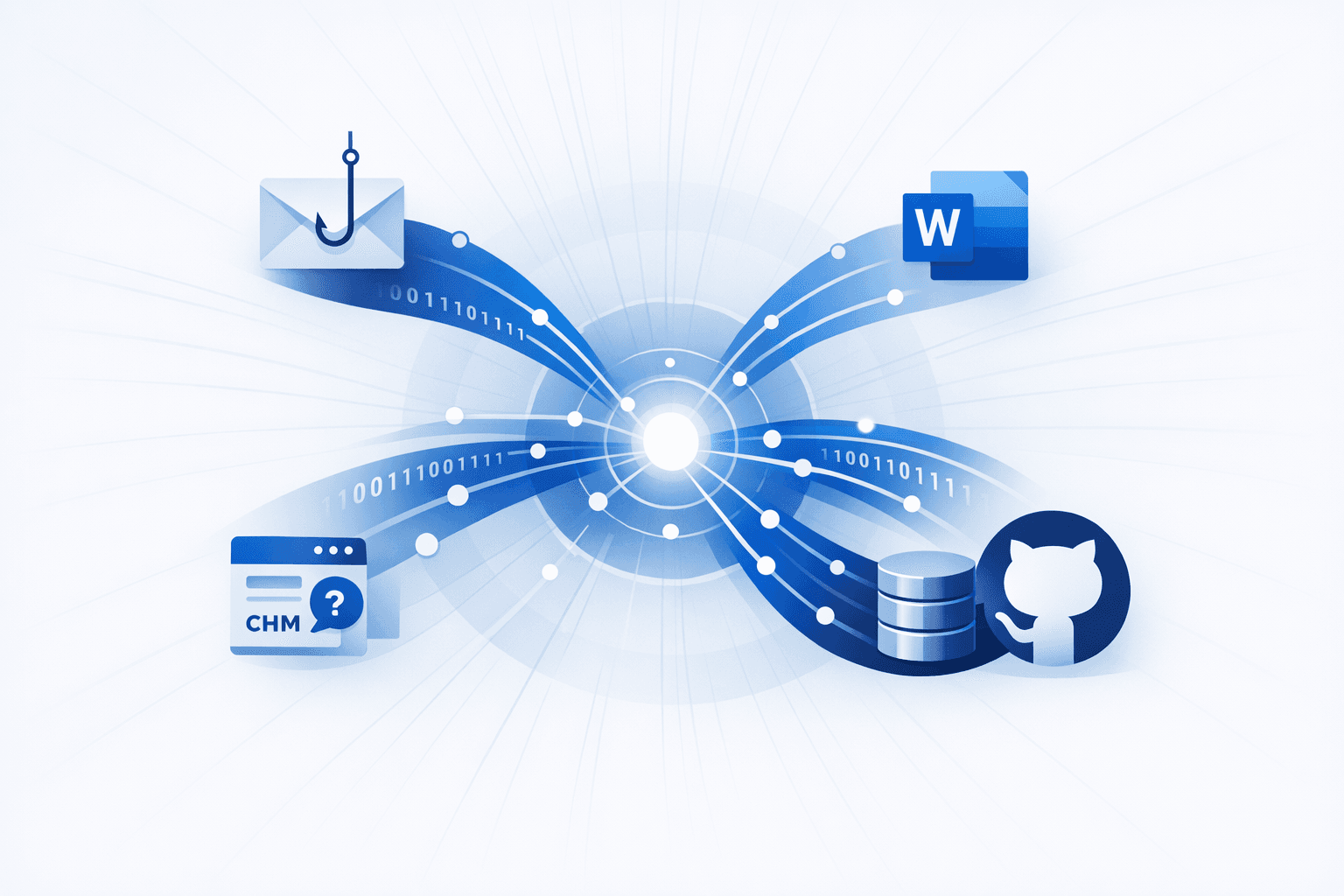
North Korea-linked **Kimsuky** has been tied to a series of phishing campaigns that delivered malware through files disguised as PDFs, resumes, questionnaires, and North Korea-related consultation documents. Across the observed intrusions, victims were lured into opening password-protected archives, enabling Office macros, or executing VBS and CHM files, after which the malware launched follow-on payloads through tools such as `wscript.exe`, `mshta.exe`, `regsvr32.exe`, and PowerShell. The implants opened decoy documents to reduce suspicion, established persistence with scheduled tasks, Startup-folder copies, or `HKCU\Run` entries, and contacted attacker-controlled infrastructure including `kro.kr`, `webcindario`, and PHP-based command-and-control endpoints. The recovered payloads show Kimsuky broadening from simple downloaders into multi-stage surveillance and theft malware. Reported capabilities include host reconnaissance, browser and email data theft, crypto-wallet artifact collection, file upload and download, keylogging, clipboard capture, active-window monitoring, and registry changes that weaken Microsoft Office security settings. Researchers also linked newer operations to a wider infrastructure ecosystem, including SharpExt-related panels and a compromised site used to deliver browser-extension malware, while one later campaign exfiltrated stolen victim data through the **GitHub API** instead of FTP, indicating continued adaptation in both delivery and collection methods.
Aug 15, 2026
North Korea-aligned threat actor **Kimsuky** has expanded operations across its **AppleSeed** and **PebbleDash** intrusion clusters, using spear-phishing documents to gain initial access and then deploying a broader malware set that includes **HelloDoor**, **httpMalice**, **MemLoad**, **httpTroy**, **AppleSeed**, and **HappyDoor**. Researchers assess with medium-high confidence that both clusters are operated by Kimsuky-affiliated actors, also tracked as **APT43** and **Ruby Sleet**, with AppleSeed showing a stronger focus on government organizations while PebbleDash activity has also reached defense-related entities in Brazil and Germany in addition to South Korean targets. The campaigns show a notable shift in post-compromise tradecraft, with operators increasingly abusing legitimate remote administration and tunneling tools such as **VSCode Remote Tunneling**, **DWAgent**, and **Cloudflare Quick Tunnels** for persistence and access. The report also notes malware development changes including the use of **Rust**, probable LLM-assisted code comments, and continued reliance on infrastructure patterns tied to free South Korean hosting domains and compromised South Korean websites, indicating that Kimsuky is modernizing its tooling while preserving long-standing operational habits.
Jun 29, 2026
North Korean state-backed threat group **Kimsuky** has been linked to an ongoing spear-phishing campaign targeting organizations and individuals in the United States, Europe, and Asia, including think tanks, research universities, government entities, and staff at Korea Risk Group. Researchers said the operation uses tailored phishing emails and **OneDrive-hosted password-protected documents** containing malicious Microsoft Office macros to gain initial access. The campaign delivers a new reconnaissance malware component dubbed **ReconShark**, assessed as an evolved variant of BabyShark. ReconShark gathers host data including running processes, battery status, and installed security products, then exfiltrates the information via HTTP `POST` requests without first writing it to disk. Based on the victim environment, the malware can also deploy follow-on payloads such as VBS, HTA, batch scripts, DLLs, malicious Office templates, and modified LNK files; supporting infrastructure was identified on NameCheap-hosted shared servers tied to domains including `yonsei[.]lol`, `rfa[.]ink`, `mitmail[.]tech`, and `newshare[.]online`.
Jun 29, 2026