Malicious Office Attachments Exploited CVE-2021-40444 to Deliver Malware
Social Engineering & Fraud · 17 sources · Updated 4mo ago · First seen May 13, 2026

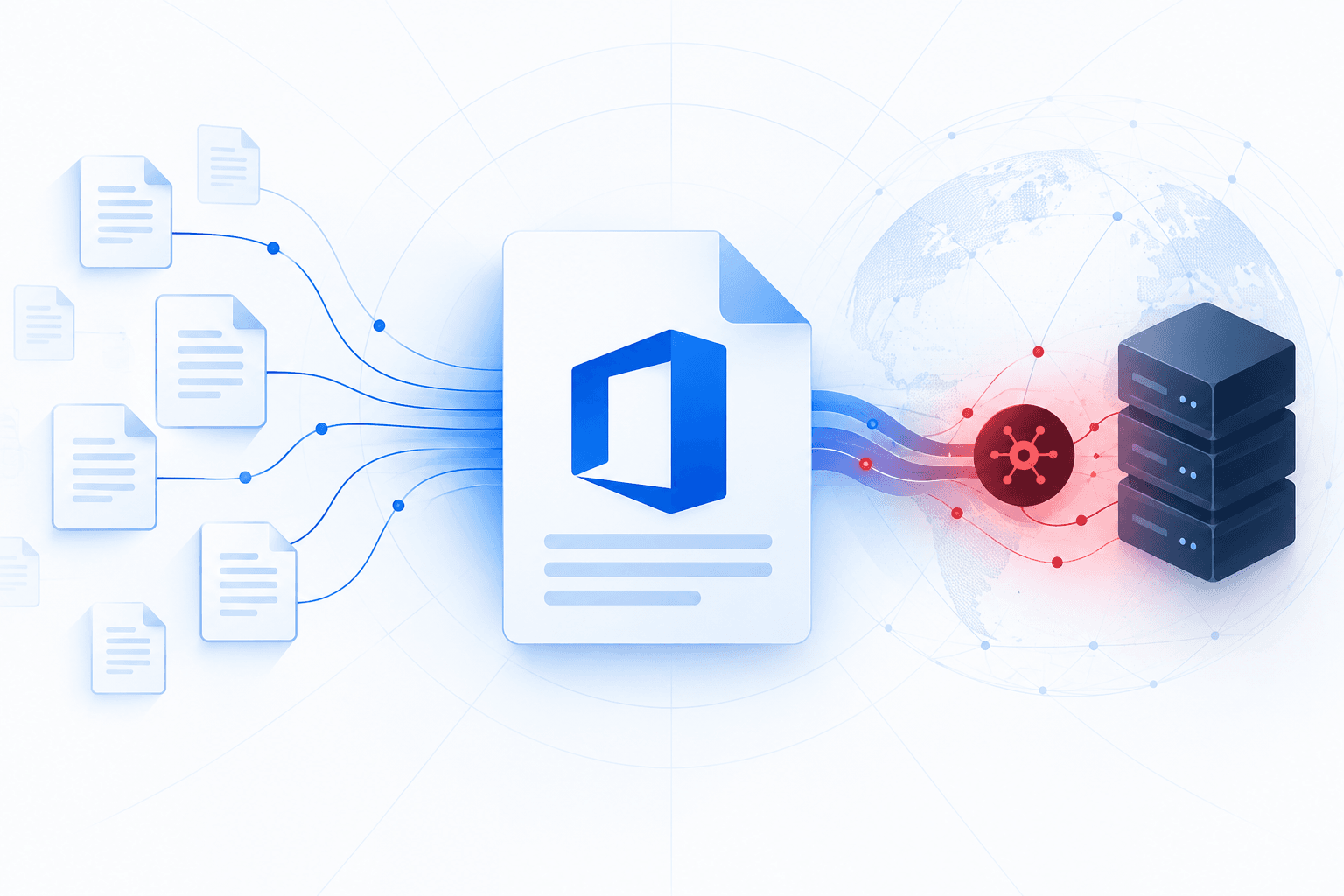
Microsoft documented CVE-2021-40444 as a remote code execution flaw in the MSHTML engine that could be triggered through specially crafted Microsoft Office documents, and security reporting tied the issue to attachment-based phishing campaigns. MITRE ATT&CK maps this activity to T1566.001 Spearphishing Attachment, a technique widely used by both state-backed and criminal actors to gain initial access through Word, Excel, RTF, PDF, archive, and shortcut files sent by email.
Security telemetry and malware analysis showed how the technique translated into real-world intrusion activity. A suspicious Word document sample analyzed in ANY.RUN and Trustwave reporting on a trojanized OneNote lure illustrate the broader pattern of weaponized Office attachments being used to execute payloads such as FormBook. Splunk also published detection guidance for spotting Office processes loading mshtml.dll, noting that such module loads can indicate exploitation of CVE-2021-40444 and may precede arbitrary code execution, data theft, or deeper compromise.
Why it matters
Impact assessment
CVE-2021-40444 enabled remote code execution through malicious Microsoft Office attachments and affected Windows systems running Office products that invoke the MSHTML engine. The exposure was significant because successful exploitation could lead to arbitrary code execution, malware delivery, data theft, lateral movement, and broader host compromise.
The activity was not purely theoretical: multiple sources described exploitation in the wild, including campaigns delivering Cobalt Strike and FormBook through phishing attachments. Scope ranged from targeted attacks at disclosure to broader global follow-on abuse across sectors including research and development, energy, industrial, banking, medical technology, telecommunications, and IT.
Affected populations and products
- Microsoft Office and Office 365 users on Windows
- Office 2019 and Office 365 on Windows 10 were explicitly cited in active attacks at disclosure
- Windows Server 2008 through 2019 and Windows 8.1 through 10 were listed as affected by Microsoft reporting
- Office-related processes specifically monitored for suspicious behavior included winword.exe, excel.exe, powerpnt.exe, mspub.exe, visio.exe, wordpad.exe, wordview.exe, onenote.exe, onenotem.exe, onenoteviewer.exe, onenoteim.exe, msaccess.exe, Graph.exe, and winproj.exe
Severity and business risk
- Microsoft assigned CVE-2021-40444 a CVSS score of 8.8
- Successful exploitation could result in arbitrary code execution
- Follow-on impacts included system compromise, data exfiltration, lateral movement, and further network penetration
- Malware families observed included Cobalt Strike and FormBook, increasing risk of credential theft, persistence, and post-exploitation activity
Scope and observed exploitation
- Exploitation was observed in the wild before patch release
- Campaigns used spearphishing attachments and malicious Office documents as the initial access vector
- Kaspersky reported ongoing worldwide exploitation attempts
- Reported victim sectors included R&D, energy, industrial, banking, medical technology, telecommunications, and IT
- Sophos described a short-lived spam campaign using a malformed RAR archive to adapt the exploit chain after patch release
- Gigamon reported likely victims in North America, Europe, and Asia
Structured facts extracted from references
- CVE: CVE-2021-40444
- Severity: CVSS 8.8
- Malware/entities: FormBook, Cobalt Strike, Microsoft, Splunk, Sophos, Trend Micro, Kaspersky, Gigamon, Trustwave, ANY.RUN, EXPMON, Mandiant
- Technique: T1566.001 Spearphishing Attachment
- Known exploitation: yes, in the wild
- Delivery formats referenced: DOCX, Word documents, RAR, CAB, INF, OneNote lure, HTML, PowerShell payloads