
Loading story…
The U.S. State Department, FBI, and allied governments warned that North Korean IT workers are obtaining freelance and full-time jobs at companies worldwide by using stolen identities, forged documents, proxy interview participants, VPNs, remote desktop tools, and overseas "laptop farms" that make them appear to be operating from trusted jurisdictions. Authorities said the workers funnel wages and cryptocurrency payments back to Pyongyang, helping fund North Korea’s nuclear weapons and ballistic missile programs while exposing employers to insider threats including data exfiltration, credential theft, and cryptocurrency theft.
The warning builds on earlier reporting and government actions showing that DPRK-linked workers have infiltrated Western technology and cryptocurrency firms under false identities, sometimes through front companies and facilitators based in Russia and China. Researchers and prior U.S. cases have tied the scheme to broader risks beyond sanctions exposure, including potential malware deployment, espionage, disruption, and money laundering, prompting officials to urge stronger identity verification, closer scrutiny of interviews and payment arrangements, monitoring for anomalous account activity, and rapid reporting of suspected hires.
See attribution, scope, and your downstream exposure.
8 events from the most recent confirmed update back to the earliest known activity.
Vangelis Stykas publicly disclosed findings from 22 months of access to systems used by North Korean hackers and scam IT workers, saying he found evidence that 1,640 organizations in 57 countries were affected and that 700 to 800 suffered especially damaging intrusions. He said the compromises included root access to servers and AWS environments, exposure of cryptocurrency-related assets, and named victims including Boston Children’s Hospital, Coinbase, Uniswap Labs, Oppo, AEON Smart Technology, Italy’s Supreme Judicial Council, an Al Rajhi Bank subsidiary, and Digitaal Vlaanderen.
On July 31, 2026, the U.S. State Department, FBI, and allied governments issued a joint advisory warning that North Korean IT workers were using stolen identities, forged documents, proxies, and remote-access infrastructure to obtain jobs worldwide. The alert said the scheme funds Pyongyang's nuclear and ballistic missile programs and creates insider-threat risks including data theft, credential compromise, and cryptocurrency theft.
On July 3, 2025, South Korea's Foreign Ministry published a press release announcing a joint advisory related to North Korean IT workers. The release indicates an official government warning about the DPRK IT worker threat prior to the later 2026 U.S.- and allies-led advisory.
On June 30, 2025, the U.S. Department of Justice announced coordinated nationwide actions against North Korean remote IT worker operations, including two indictments, an arrest, a plea agreement, searches of laptop farms, and seizures of financial accounts, websites, and computers. DOJ said the schemes used stolen or fake identities to place workers at more than 100 U.S. companies, generated millions in revenue, and in some cases enabled theft of sensitive data and cryptocurrency.
OpenAI reported banning ChatGPT accounts linked to multiple deceptive employment campaigns that used AI to support fraudulent remote IT job applications. It said the activity was behaviorally consistent with publicly attributed North Korea-linked IT worker schemes and disclosed operational details including automated resume generation, interview assistance, contractor recruitment, and research into remote-access tooling.
On February 1, 2025, OpenAI published a case study on an AI-assisted deceptive employment scheme and said it banned dozens of accounts involved. The activity was described as consistent with publicly reported North Korea-linked IT worker tradecraft, including fake applicant materials, interview assistance, remote-access tooling, and recruitment of U.S.-based helpers to receive laptops or lend identities.
On November 22, 2024, Microsoft published intelligence from its CYBERWARCON presentations describing North Korean IT workers operating under false identities and supported by facilitators providing accounts, banking, SIMs, and job-platform access. Microsoft also said it had found a public repository in October 2024 containing resumes, infrastructure details, playbooks, and evidence of AI-enabled identity fraud and voice-changing experimentation.
North Korea's Foreign Ministry publicly denounced the 11-country advisory on its alleged IT worker schemes, calling the accusations politically motivated and intended to damage the country's image. In a statement carried by KCNA, a spokesperson accused the United States of fabricating a cyber-threat narrative to justify pressure on Pyongyang and deepen confrontation.
Vulnerabilities, threat actors, malware, products, organizations, and breaches Mallory has linked to this story.
See attribution, scope, and whether this vendor sits anywhere in your supply chain.
13 references tracked. Mallory keeps watching after this page renders.
wired.com
Open sourceteiss.co.uk
Open sourcenknews.org
Open sourcenknews.org
Open sourceopenai.com
Open sourcemargin.re
Open sourcemicrosoft.com
Open sourceic3.gov
Open sourceMap indicators from this story to your assets and identify affected systems in minutes.
Every observed campaign, victim, and pivot linked to actors named in this story.
Malware, exploits, and IOCs connected to the activity described here.
YARA, Sigma, and Snort rules deployed to your SIEM as soon as they’re published.
Get matching new stories delivered to your team as they break — not the next morning.
Ask questions about this story and take action on the answers.
Other stories Mallory is tracking that overlap on entities, sources, or topic labels.

U.S. authorities and multiple security firms detailed a large North Korean scheme in which operatives use stolen or fabricated identities to win remote IT jobs at Western companies, then send the earnings back to Pyongyang in violation of sanctions. Research from IBM X-Force, Flare, Microsoft, LevelBlue, and others described a mature ecosystem of recruiters, facilitators, brokers, laptop-farm operators, and Western collaborators that helps workers pass interviews, receive corporate devices, mask their locations with VPNs, and clear payroll and compliance checks. Estimates cited across the reporting say more than 100,000 workers operating across dozens of countries may be generating roughly **$500 million annually**, while some cases also involved data theft, source-code exfiltration, extortion, and malware activity after hiring. The U.S. Treasury's Office of Foreign Assets Control sanctioned six individuals and two entities tied to the operation, while U.S. courts sentenced three Americans, including a former Army soldier, for helping North Korean workers use false identities and laptop farms to obtain jobs at U.S. companies. Investigations also exposed operational tradecraft including use of **Astrill VPN**, **NetKey/OConnect**, **IP Messenger**, freelance platforms, AI-generated resumes and headshots, and U.S.-based hardware relays such as PiKVM-enabled laptop farms; one hired worker was removed within 10 days after suspicious logins from China and Missouri triggered detection. Researchers and federal advisories warned that remote hiring has become an insider-threat and sanctions-compliance risk, urging tighter identity verification, live skills testing, device and geolocation controls, least-privilege access, and joint oversight by HR, recruiters, and security teams.
Aug 18, 2026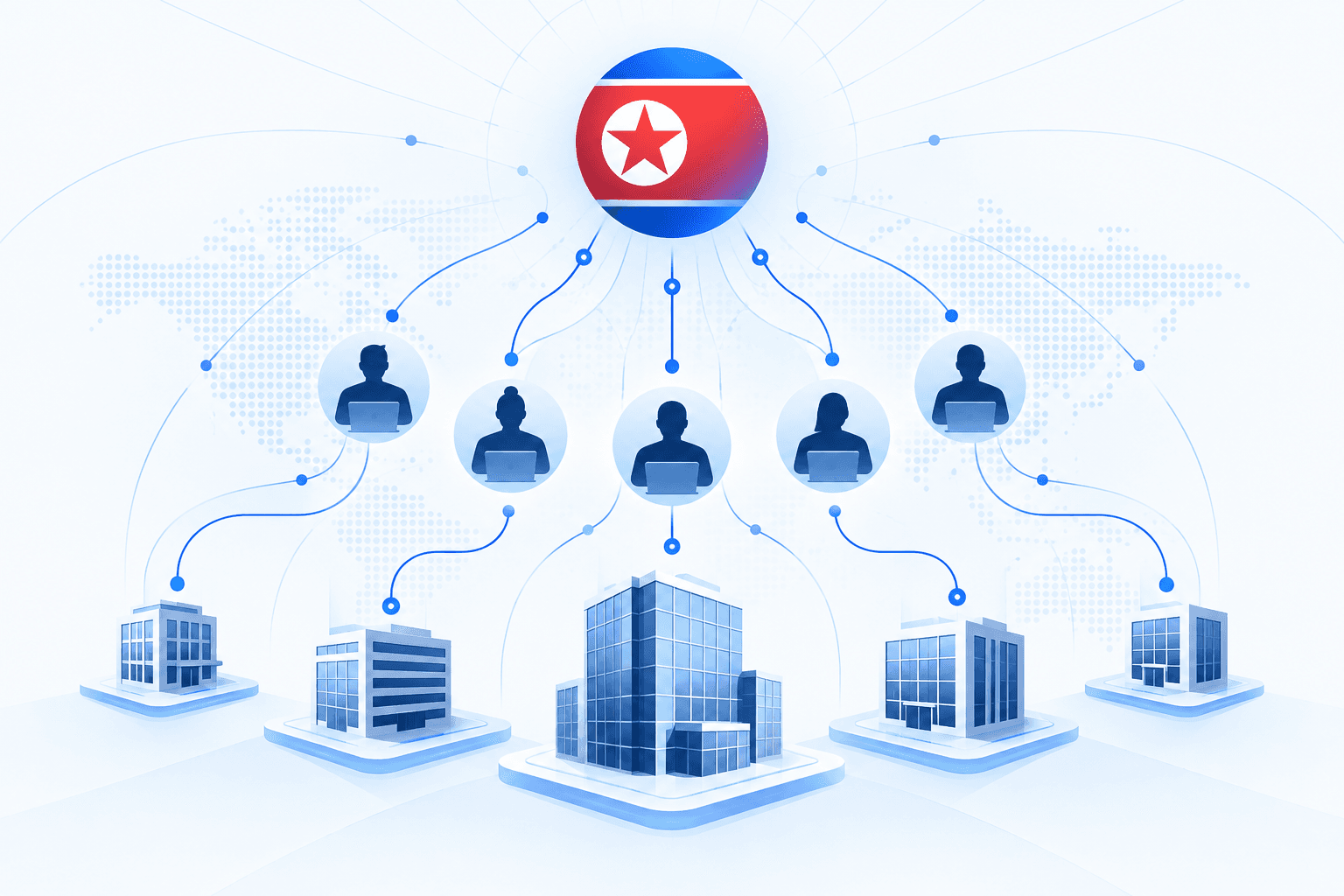
A multinational government alert warns that North Korean IT workers are fraudulently securing remote jobs at companies worldwide using stolen or fabricated identities, forged documents, interview proxies, VPNs, remote-desktop tools, and overseas laptop farms. The activity generates revenue for Pyongyang's prohibited nuclear-weapons and ballistic-missile programs, while potentially exposing employers to sanctions violations and insider threats including data theft, cryptocurrency theft, and exfiltration of sensitive information. Reporting indicates North Korea is also recruiting talent abroad to expand infiltration of U.S. companies and facilitate associated money-laundering activity. Employers, staffing firms, and online work platforms should strengthen identity and right-to-work verification and investigate anomalies in interviews, account activity, device locations, payment methods, and requests to route company laptops through third parties; UN Security Council Resolution 2397 generally requires states to repatriate North Korean nationals earning income in their jurisdictions.
Sep 18, 2026
Recorded Future's Insikt Group reported that a North Korean operation it tracks as **PurpleDelta** has used fake identities to pursue remote IT jobs at more than 1,100 companies, primarily targeting North American firms. Active since late 2024 and allegedly operating mainly from Shenyang, China, the cluster used at least 22 fabricated personas, AI-generated profile photos, forged identity documents, and recruitment infrastructure including `minicursor.com` and `trustidcard.com` to move through hiring pipelines. Investigators said the operators relied on transcription, screen recording, remote access, translation, and collaboration tools during interviews and after hiring, while in-country facilitators maintained company-issued laptops and other devices tied to victim organizations. The activity has been described as a new form of insider threat in which access is obtained during recruitment rather than abused after legitimate employment begins. SC Media reported that the FBI is investigating a North Korean remote IT worker employed by a U.S. federal agency, while broader estimates cited from the U.N. say such schemes have embedded operatives in hundreds of private-sector companies and generate **$250 million to $600 million annually**. The campaigns reportedly use stolen identities, deepfakes, VPN-masked locations, and U.S.-based laptop farms to secure remote roles and, in some cases, exfiltrate sensitive data, exposing gaps in conventional background checks and insider-threat programs.
Aug 25, 2026