Consumer-Facing Phishing and Payment Scams Using Fake Support and Fraud Alerts
Social Engineering & Fraud · 76 sources · Updated 5mo ago · First seen Feb 22, 2026
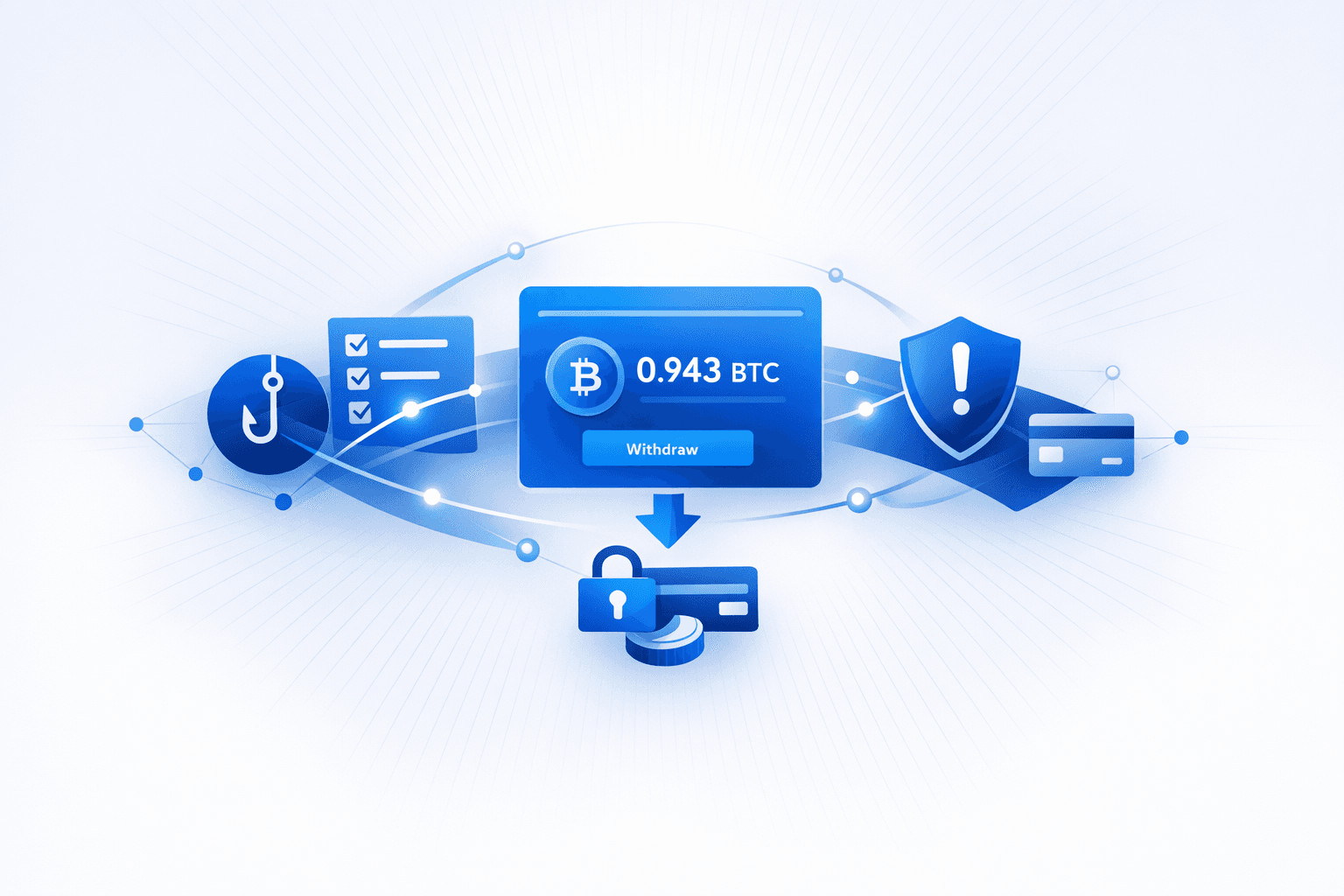
Multiple reports describe social-engineering scams that impersonate trusted brands and payment providers to drive victims into credential theft or direct monetary loss. A “crypto compensation” lure abuses a legitimate-looking Yandex poll as an entry point, then redirects victims to a fake Bitcoin payout page claiming an approved 0.943 BTC transaction and imposes a small “commission”/fee to withdraw funds—classic advance-fee fraud wrapped in a polished, multi-step funnel (including a fake chat “support agent”). Separately, Japanese-language phishing emails impersonating ANA, DHL, and myTOKYOGAS show consistent infrastructure patterns (notably .cn domains in sender and landing-page URLs), suggesting a single operator or shared kit targeting Japanese-speaking recipients.
Several consumer scam advisories highlight SMS-based fraud alerts that push targets to call attacker-controlled phone numbers, where scammers pose as “support” to steal Apple ID/2FA codes or payment details, or to coerce victims into moving money. One PayPal-themed case escalated to cash withdrawals handed to a courier after a victim called a number from an unsolicited text, illustrating how “fraud department” pretexts can transition from phishing to cash-out theft. Additional warnings cover lookalike payment sites (e.g., payyourbill.aps medical.com) and generic guidance on what to do after clicking a phishing link; these are broadly consistent with the same theme (phishing/payment fraud) but are not tied to a single, specific campaign or actor across all items.
Why it matters
Impact assessment
This story reflects a broad, consumer-facing fraud ecosystem centered on phishing, smishing, vishing, fake support, and advance-fee payment scams rather than a single malware campaign. Affected populations include retail banking customers, cryptocurrency users, payment-platform users, online marketplace sellers, mobile subscribers, and Japanese-speaking email recipients; impact ranges from credential theft and account takeover to direct financial loss, cash-out theft, identity exposure, and reputational harm to impersonated brands.
The scope is widespread and opportunistic across multiple brands and channels, with some clusters showing repeatable infrastructure and tradecraft. There are clear reports of active exploitation in the wild, including real victim losses, courier cash pickup, account takeover attempts, and recurring phishing infrastructure tied to Apple Pay, PayPal, Venmo, Coinbase, Robinhood, CoinSpot, NCB, USPS, Evri, DPD, ANA, DHL, and myTOKYOGAS impersonation.
Affected entities and populations
- Consumers using Apple Pay, PayPal, Venmo, Coinbase, Robinhood, CoinSpot, Crypto.com, Revolut, Bank of America, NCB, and Kaiser Permanente services.
- Online marketplace sellers, including Facebook Marketplace users, targeted with fake payment confirmations and advance-fee lures.
- Japanese-speaking recipients targeted with brand-themed phishing emails impersonating ANA, DHL, and myTOKYOGAS.
- Retail and parcel-delivery customers targeted through USPS, Evri, and DPD delivery-payment lures.
- Cryptocurrency users targeted through fake support, fake withdrawal alerts, fake payout notices, and recovery-phrase theft.
Severity and business impact
- Direct monetary theft through fake support calls, fraudulent fees, fake invoices, and coerced transfers.
- Account takeover risk where victims disclose passwords, OTPs, MFA codes, Apple ID credentials, Venmo verification codes, Robinhood/Coinbase/Crypto.com credentials, or Ledger recovery phrases.
- Secondary fraud risk from harvested personal data, payment card details, SSNs, and banking information.
- Potential device compromise where scammers persuade victims to install remote-access tools such as AnyDesk or TeamViewer.
- Brand abuse and customer-support burden for impersonated providers.
Scope and exploitation status
- Activity is widespread across SMS, email, voice calls, WhatsApp, fake websites, PDF attachments, and legitimate-platform abuse such as PayPal invoicing and real microtransactions.
- Several references describe recurring infrastructure patterns rather than isolated one-offs.
- Known real-world exploitation includes:
- PayPal-themed fraud escalating to cash withdrawal and courier pickup.
- PayPal microtransaction scams using real 0.01 MXN, 1 JPY, 0.11 PHP, or $0.02 transactions to increase credibility.
- Ongoing Japanese-language phishing using
.cnsender and landing-page domains. - Active crypto advance-fee scam infrastructure using Yandex poll redirects and newly registered domains.
Technical details
This story contains no software vulnerabilities or CVEs; the technical risk is social-engineering tradecraft supported by phishing infrastructure, spoofed identities, fake support numbers, and legitimate-platform abuse. The most actionable details are phone numbers, domains, email addresses, sender artifacts, and repeatable tactics such as OTP harvesting, remote-access coercion, fake invoice callbacks, and microtransaction-based pretexting.
CVEs and severity
- No CVEs or CVSS scores were identified in the referenced material.
Core attack vectors and mechanics
- SMS phishing and vishing using fake fraud alerts, unauthorized withdrawal notices, locked-account claims, and OTP/reference-code lures.
- Email phishing using fake invoices, fake subscription renewals, fake billing notices, and fake payout notifications.
- Callback phishing where victims are instructed to call attacker-controlled numbers.
- Credential harvesting through cloned login pages and fake payment portals.
- Advance-fee fraud requiring a small payment to unlock fake funds or rewards.
- Abuse of legitimate services to increase credibility:
- PayPal invoicing and money requests.
- Real PayPal microtransactions.
- Legitimate-looking Yandex poll links as redirectors.
- GovDelivery-related infrastructure in BlockFi-themed scams.
- Remote-access coercion using AnyDesk or TeamViewer in support-themed scams.
Indicators of compromise and observables
Phone numbers
- 888-743-4760
- 1-888-593-6001
- 1(805)661-1724
- +1 864-205-3604
- 1-888-717-6077
- 1-656-556-2147
- 407-612-7120
- 833-418-6291
- +1-818-647-6959
- +1(888) 708-5771
- +61 897 176 715
- +61 348 307 269
- 855-629-1161
- 719-408-0000
- 888-341-5322
- 682-564-8025
- 888-632-2011
- 888-912-2470
- 888-274-5277
- 1-800-613-9844
- +1 833-445-3880
- 1-808-371-1635
- 1-810-353-2779
- 1(808)221-2318
- 876-821-8904
- +2126327088
- +2126327088 18
- 559-754-9420
Domains, URLs, and email addresses
- hxxps://yandex[.]com/poll/PdZ7vgekGrNakuXZcpiB6b
- hxxps://yandex[.]com/poll/GjSFvwyKcmEMXpzm6yDExc
- hxxps://cosibas[.]site/bloc/anketa-sent.html
- hxxps://cosibas[.]site/octa/
- hxxps://paybits[.]cc/payment/
- cosibas[.]site
- paybits[.]cc
- ncbonlinefiles.info
- costcosaved.com
- grocerysaved.com
- mcrev.store
- nfeeds.com
- schylling.us.com
- schyllingstore.us.com
- schylling.store.us.com
- schyllings.it.com
- schylinngtooys.us.com
- giffgaff-active.com
- mub.me
- evri-mydelivery.com
- evr.i
- member.llbyzmf@ncqjw[.]cn
- dmail.elthr@obpwnrl[.]cn
- reportogkfgkbye@cwqfvzp[.]cn
- hxxps[:]//branchiish.aayjlc[.]cn/amcmembr_Loginam/
- hxxps[:]//decideosity.ykdyrkye[.]cn/portal_login_exp/getQuoteTab/
- hxxps[:]//impactish.rexqm[.]cn/mtgalogin/
- info@buah.de
- lynnwoodwa@service.govdelivery.com
- no-reply@TrumpAccounts.Treasury.gov
- phishing@venmo.com
- phishing@paypal.com
- spoof@paypal.com
- reportphishing@apple.com
- security@coinbase.com
- support@coinspot.com.au
- reportfraud@jncb.com
- ncbinfo@jncb.com
- internetfraude@infomedics.nl
- scam@mcafee.com
- spam@norton.com
- phishing@shopify.com
- phishing@evri.com
- abuse@bankofamerica.com
- elon-musk@model-v.online
- elon09471@gmail.com
- jamminhaas@gmail.com
- sheila.norman@outlook.com
Structured facts by campaign cluster
Crypto compensation / fake payout scam
- Entry via Yandex poll links, then redirect to fake BTC compensation pages.
- Fake approved payout examples: 0.943 BTC and 1.824 BTC.
- Withdrawal blocked pending commission or registration fee: $67 or about $69.
- Payment pages provide BTC QR codes, wallet addresses, and countdown timers.
- Octa-themed variant uses fake transfer dashboard, temporary password, and OTP-style flow.
- Newly registered domains observed: cosibas[.]site on 2026-01-30 and paybits[.]cc on 2026-02-02.
Japanese-language phishing cluster
- Impersonated brands: ANA, DHL, myTOKYOGAS.
- Sender and landing-page infrastructure consistently uses
.cndomains. - Shared header artifact:
X-mailer: Foxmail 6, 13, 102, 15 [cn]. - Source IPs observed:
- 150.5.129[.]136
- 101.47.78[.]193
- 150.5.130[.]42
- Pattern suggests a single operator or shared phishing kit.
Apple-themed support and fraud-alert scams
- Repeated lures claim unauthorized Apple Pay charges, suspicious Apple ID activity, or account suspension.
- Known fake support numbers include 888-743-4760, 1-888-593-6001, 1(805)661-1724, and +1 833-445-3880.
- Sample fraud amounts include $142.93, $489.95, and $1987.99; sample invoice 1880939; Target Stores in San Jose referenced in one lure.
- Follow-on objectives include Apple ID credential theft, 2FA code theft, payment-card theft, and remote-access installation.
PayPal invoice / callback scam cluster
- Repeated use of fake invoices, fake Coinbase/Bitcoin charges, and fake support numbers.
- Some messages appear to come from service@paypal.com because attackers abuse legitimate PayPal invoicing.
- Recurrent lure amount: about $3544; other amounts include $980, $987.90, $1489.99, and $649.00.
- Real microtransactions used to validate the pretext: 0.01 MXN, 0.12 MXN, 1 JPY, 3 JPY, 0.11 PHP, 1 PHP, and $0.02.
- Business names used as invoice references include Askew Nextgen Synergies LLC, 4019 W SAN LUIS LLC, Avram Bytewave LLC, Dalesi Corp, Attaurre Tech7Mart LLC, EB JV Jared LLC, ARTURO ACEITUNO D.M.D. LLC, AVERY RSUMMIT TECHNOLOGIES LLC, 1520 Gary Road LLC, SJ3 Norman Enterprises, Sandra LLC, Julie Haas, and Sandra Bermon.
- Fake support numbers observed across this cluster include 1-888-717-6077, 1-656-556-2147, 855-629-1161, 719-408-0000, 888-341-5322, 682-564-8025, 888-632-2011, 888-912-2470, 888-274-5277, and 1-800-613-9844.
Crypto exchange and fintech impersonation
- Coinbase, Robinhood, CoinSpot, Crypto.com, Venmo, Revolut, and PayPal are repeatedly impersonated.
- Common mechanics:
- unsolicited OTP or withdrawal code messages
- fake suspicious-login alerts
- instructions to call support
- requests for MFA codes or passwords
- instructions to move funds to a “safe wallet” or “safe account”
- CoinSpot-specific scam numbers: +61 897 176 715 and +61 348 307 269.
- Robinhood sample lure: withdrawal code 318475, ref PRL91746, fake number +1(888) 708-5771.
- Venmo scams include requests for MFA codes and remote-access installation via AnyDesk or TeamViewer.
Banking, healthcare, and delivery impersonation
- NCB phishing uses ncbonlinefiles.info and sender 876-821-8904.
- Bank of America scams use spoofed caller ID, including 800-432-1000 and robocall callback 833-418-6291.
- Kaiser Permanente scams use caller-ID spoofing and may target Mandarin speakers.
- USPS scam uses PDF attachments linking to fake USPS sites and small redelivery-fee lures.
- Evri and DPD scams use failed-delivery and redelivery-fee pretexts with lookalike domains and SMS links.
Relevant MITRE ATT&CK techniques
- T1566.001 Spearphishing Attachment
- T1566.002 Spearphishing Link
- T1566.003 Spearphishing via Service
- T1583.001 Acquire Infrastructure: Domains
- T1586.002 Compromise Accounts: Email Accounts
- T1656 Impersonation
- T1204 User Execution
- T1056 Input Capture, in the form of credential harvesting on fake portals
- T1078 Valid Accounts, following OTP/MFA theft and account takeover
- T1219 Remote Access Software, where AnyDesk or TeamViewer are used
- T1646 Hide Artifacts, via caller ID spoofing and sender spoofing
Recommended response
Security teams should treat this as a detection and user-protection problem, not a patching event. Priorities are to block known scam infrastructure, tune detections for callback-phishing and OTP-harvesting patterns, monitor for brand impersonation against employees and customers, and reinforce user workflows that require direct verification through official apps and portals.
Organizations with consumer-facing brands, financial workflows, or customer-support operations should immediately review whether their users or staff are being targeted by these lures. Longer term, reduce exposure by hardening MFA, limiting SMS-based verification, improving anti-phishing controls for SMS/email/voice, and publishing clear support-contact guidance to customers and employees.
Immediate actions
- Block or flag the listed domains, URLs, and phone numbers in email, web, DNS, SMS, and telephony security controls where supported.
- Hunt for inbound messages containing combinations of:
- unauthorized charge
- suspicious login
- withdrawal code
- account locked
- call support immediately
- secure wallet
- pending deposit to Coinbase via PayPal
- Apple Security Alert
- legal profile registration
- Review email gateways for messages containing PayPal invoice notes, PDF invoice attachments,
.cnsender domains, and Foxmail header artifacts. - Alert fraud, SOC, and customer-support teams to callback-phishing patterns and real microtransaction pretexts.
- If your organization supports customers, publish or refresh official guidance that support will never request OTPs, passwords, recovery phrases, or remote-access installation.
Detection and hunting opportunities
Email and web hunting
- Search for inbound mail with sender or reply-to domains ending in
.cncombined with Japanese-language brand terms ANA, DHL, or myTOKYOGAS. - Search for header artifact:
X-mailer: Foxmail 6, 13, 102, 15 [cn]. - Search for PayPal-themed emails containing seller-note phone numbers, Coinbase references, Bitcoin references, or high-value invoice amounts around 980, 987.90, 1489.99, 199.99, or 3544.
- Search for messages containing known suspicious domains such as
ncbonlinefiles.info,costcosaved.com,grocerysaved.com,mcrev.store,nfeeds.com,cosibas.site, andpaybits.cc. - Search for PDF-bearing SMS/email delivery lures referencing USPS redelivery or incomplete address.
Identity and account monitoring
- Monitor for spikes in OTP generation followed by help-desk or support contact.
- Review account-takeover telemetry for users who recently received suspicious SMS or email and then changed MFA factors, passwords, or payout settings.
- For crypto or payment platforms, monitor for user actions consistent with scammer instructions, including transfers to newly added external wallets or “safe wallet” destinations.
Telephony and support workflows
- Flag inbound reports mentioning the listed callback numbers.
- Train support staff to recognize scam escalation patterns involving:
- requests to verify OTPs
- claims of unauthorized crypto withdrawals
- requests to move funds to a safe wallet/account
- requests to install AnyDesk or TeamViewer
- claims of accidental overpayment or escrow holds
User and customer remediation steps
- If a user called a scam number or entered credentials, immediately reset passwords, revoke sessions, review MFA settings, and remove unknown devices.
- If OTPs, Apple ID codes, Venmo codes, or crypto recovery phrases were disclosed, assume account compromise and initiate account recovery immediately.
- If remote access was granted, isolate the device, remove remote-access tools, run EDR/AV scans, and review for persistence or credential theft.
- If payment-card or bank data was exposed, contact the financial institution, freeze or replace cards, dispute charges, and monitor for follow-on fraud.
- If Ledger recovery phrases were exposed, move assets to a new wallet with a newly generated seed phrase.
Longer-term hardening
- Reduce reliance on SMS-based MFA; prefer authenticator apps or phishing-resistant MFA where possible.
- Implement brand-monitoring for lookalike domains and abuse of legitimate notification systems.
- Add detections for callback-phishing language in email and SMS security tooling.
- Strengthen customer-facing anti-fraud messaging in apps, portals, and transaction notifications.
- Coordinate with telecom, email, and payment providers for takedown and abuse reporting using the listed observables.