Latvia Arrests Suspect in TSC Customer Data Theft and Extortion Attempts
Regulatory & Policy · 2 sources · Updated 2mo ago · First seen Sep 23, 2026
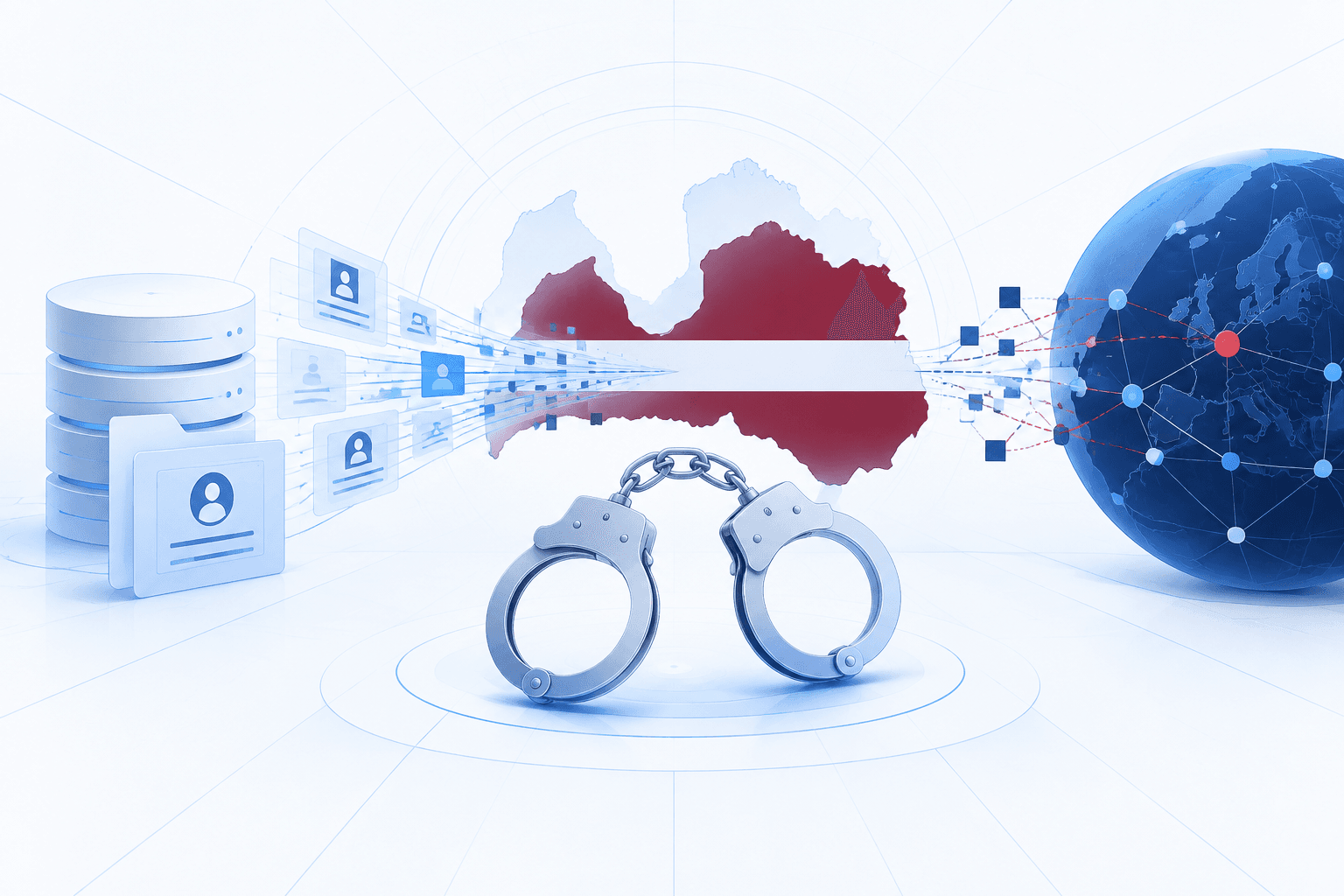
Latvian police arrested an unnamed 23-year-old man suspected of breaching at least two companies, stealing personal information and attempting to extort the victims. Investigators allege that he exploited website vulnerabilities to access corporate databases, exfiltrated data, and used anonymous email accounts to demand payment in exchange for not disclosing the theft.
One confirmed victim was TSC, an electronics-repair company within the LMT telecommunications group. Attackers accessed TSC's database of customer repair requests in early September; police said a similar intrusion had been detected in February. A search of the suspect's Riga home uncovered evidence of possible additional attacks against businesses in Latvia and abroad, which remain under investigation.
Why it matters
Impact assessment
TSC customers in Latvia, Lithuania, and Estonia may face targeted fraud, account compromise, physical-security risks, and privacy harm after attackers accessed repair-request records. The incident is a confirmed data theft and extortion case; no evidence indicates compromise of LMT telecommunications networks or other LMT group companies.
Supporting facts
- Affected organization: TSC, an electronics-repair business in the LMT telecommunications group.
- Potentially exposed data: customer names, contact details, addresses, bank-account numbers, device passcodes, and building access codes. Exposure varies by the information a customer supplied in a repair request.
- Consequences: device passcodes can enable access to devices submitted for repair; bank and contact data support phishing and financial fraud; address and building-access information creates physical-security exposure.
- Scope: the number of affected TSC customers is undisclosed. Latvian police attribute at least two company intrusions to the suspect and found evidence suggesting further victims in Latvia and abroad.
- Confirmed activity: the first intrusion was detected in February; a similar second intrusion affected TSC in early September. Authorities state the stolen information does not appear to have been shared with third parties.
- Extortion was attempted through anonymous email accounts. The available reporting does not establish whether any victim paid.
Technical details
The suspect allegedly used automated tools to scan public websites and online resources for vulnerabilities, exploited vulnerable websites to reach corporate databases, exfiltrated personal data, and attempted extortion. No CVE, vulnerable product, exploit payload, malware, email address, IP address, domain, file hash, or other actionable IOC has been published.
Structured facts
- Suspect: unnamed 23-year-old male, arrested by Latvian police on 2026-09-15 in Riga.
- Victim: TSC, part of the LMT group; operates in Latvia, Lithuania, and Estonia.
- Initial access: exploitation of an undisclosed website vulnerability.
- Target resource: TSC database containing customer repair requests.
- Reconnaissance: alleged automated scanning of websites and online resources for vulnerabilities rather than selection of specific named targets.
- Collection and exfiltration: unauthorized database access and extraction of personal information.
- Extortion: anonymous email accounts used to demand payment in exchange for not disclosing stolen data.
- Defense evasion: investigators state the suspect used digital tools to conceal his actual location.
- CVEs/CVSS: none disclosed.
- IOCs: none disclosed.
- Affected configuration/version: undisclosed website vulnerability and undisclosed database environment.
- LMT scope: TSC states its IT systems are segregated from other LMT companies; no indication exists that LMT's telecommunications network was compromised.
Relevant MITRE ATT&CK techniques
- T1595 – Active Scanning: alleged automated scanning for vulnerable websites and online resources.
- T1190 – Exploit Public-Facing Application: alleged exploitation of website vulnerabilities to gain database access.
- T1213 – Data from Information Repositories: access to customer repair-request database.
- T1567 – Exfiltration Over Web Service: data theft is reported, but the exfiltration channel is not disclosed; map only as a potential analytic category.
- T1657 – Financial Theft: extortion demand tied to threatened disclosure of stolen data.
- T1568 / T1090 – Dynamic Resolution / Proxy: location concealment is reported, but the specific service or mechanism is not disclosed; do not assert either technique as confirmed.
Recommended response
Organizations operating public-facing repair, support, CRM, and customer-request portals should immediately assess web-application exposure and investigate abnormal database access, especially where records contain device credentials or physical-access information. Treat any customer record containing device passcodes, bank details, or building codes as high sensitivity and activate incident response if unauthorized access is identified.
Priority actions
-
Patch and contain
- Identify all internet-facing websites, APIs, customer portals, and repair-request applications.
- Patch known vulnerabilities in their web stacks, frameworks, plugins, CMS components, API gateways, and database connectors; remove unsupported components.
- Conduct authenticated vulnerability scanning and targeted manual testing of database-backed forms, authentication, authorization, injection flaws, file handling, and API endpoints.
- Restrict database connectivity to application service accounts and private network paths. Prevent direct public database access.
- Rotate database, application, API, and administrative credentials if compromise is suspected.
-
Investigate exposure
- Review web-server, WAF, application, identity, database audit, and outbound network logs from February 2026 onward, prioritizing externally exposed customer-data applications.
- Hunt for anomalous bulk reads, large exports, use of unusual database queries, requests to administrative or debug paths, and database access by web-service accounts outside normal application behavior.
- Confirm whether repair/service records store unnecessary device passcodes, full bank-account data, building codes, or other sensitive customer data. Remove or tokenize data that is not operationally required.
- Validate segmentation between subsidiaries and business units, particularly where a service provider processes customer data for a larger corporate group.
-
Detect and monitor
- Alert on high-volume requests, endpoint enumeration, repeated HTTP 4xx/5xx responses followed by successful requests, suspicious parameters, and automated user-agent patterns against public applications.
- Alert on abnormal SELECT/export activity against customer-record tables, especially reads involving passcodes, payment-related fields, addresses, or access-code fields.
- Monitor outbound traffic from web and application servers for uncharacteristic data volume or destinations, and retain logs sufficiently long to support retrospective investigations.
- Monitor corporate mailboxes and security reporting channels for extortion messages, including messages threatening disclosure of customer data. Preserve full headers and message artifacts for law enforcement and incident-response review.
-
Reduce downstream harm
- If records containing device passcodes or building codes were exposed, notify affected customers through verified channels and direct them to change passcodes and physical access codes where feasible.
- Coordinate with financial institutions and privacy counsel if bank-account information was exposed. Prepare fraud-monitoring and customer-support procedures.
- Implement data-minimization rules: prohibit collection of building access codes in standard repair tickets, avoid storing device passcodes unless essential, and enforce automatic deletion after service completion.
Detection note
No published IOC supports a signature-based block or indicator hunt. Detection should focus on behavior: automated web scanning, exploitation attempts against public applications, unusual application-to-database access, mass customer-record retrieval, and outbound exfiltration from application infrastructure.