Mallory
← Back to News
state-sponsored-espionagephishing-campaign-intelligencepersistence-methodcommand-and-control-method

Kimsuky LNK Malware Using Dropbox API for Host Profiling and Payload Delivery

Threat Actor Intelligence · 8 sources · Updated 5mo ago · First seen Mar 19, 2026
Kimsuky LNK Malware Using Dropbox API for Host Profiling and Payload Delivery

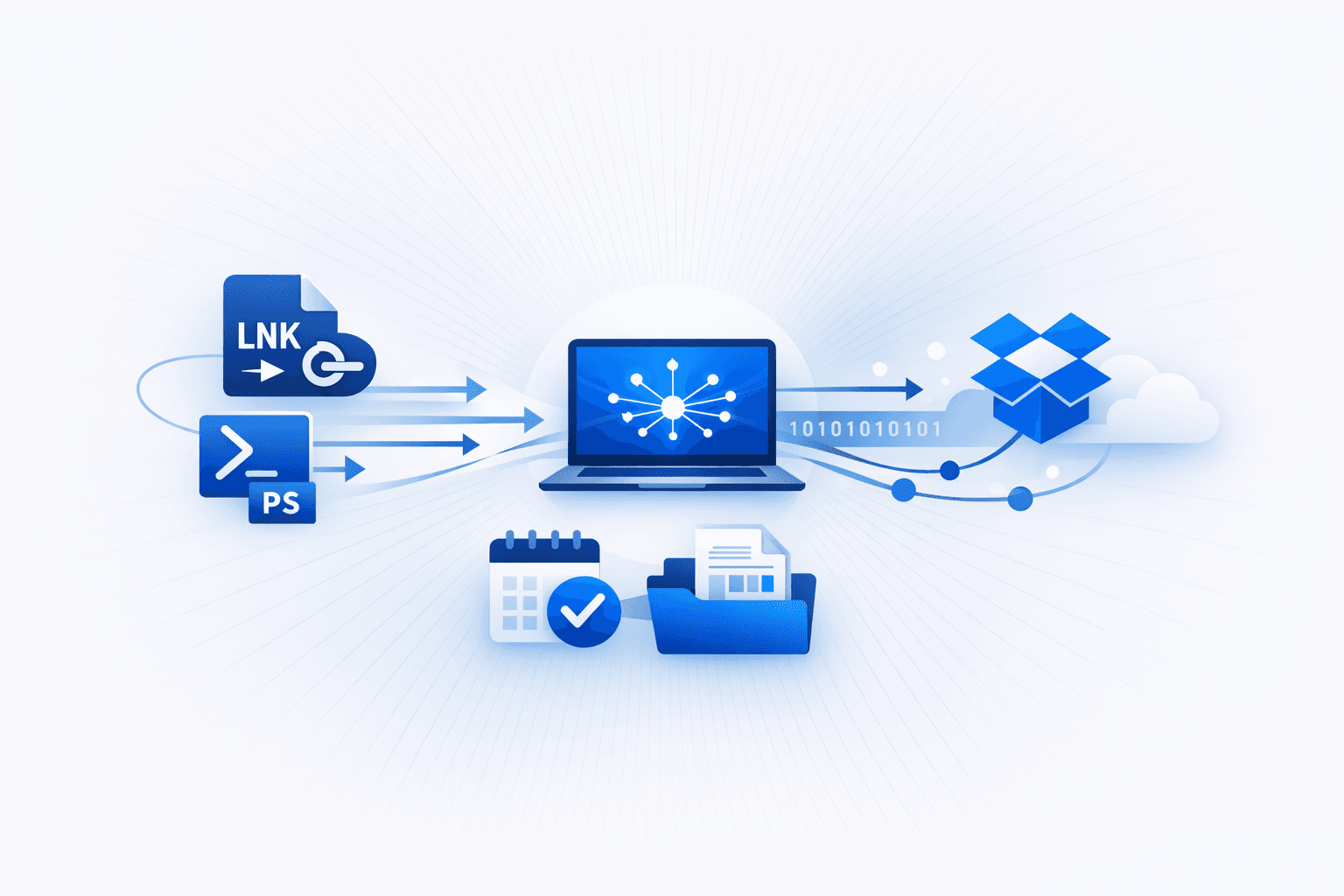
Kimsuky-linked malware delivered through malicious LNK files was observed targeting likely South Korean users, using shortcut execution to unpack a PowerShell-based implant, establish persistence via Task Scheduler, collect host information, and communicate through the Dropbox API. IIJ reported that the LNK extracts files into C:\PerfLog, deploys www.ps1 and a VBScript launcher, creates a scheduled task named P, and drops a decoy document in a Hancom Office format. The malware generates a client ID from the victim MAC address, gathers system details including domain, username, OS version, process lists, and external IP address, then uploads the data to attacker-controlled Dropbox folders before attempting to download and run a follow-on batch payload.

AhnLab's February 2026 APT trend reporting for South Korea provides broader context showing that spear phishing remained the dominant delivery method and that LNK-based attacks were the most prevalent format observed, including campaigns that used PowerShell to fetch additional components and register persistence. While AhnLab's report is a monthly trend overview rather than a dedicated write-up on the Dropbox variant, it aligns with IIJ's assessment that the malware shares substantial TTP overlap with previously reported Kimsuky activity. The reporting indicates continued abuse of legitimate cloud services such as Dropbox and, more broadly, GitHub and similar platforms to blend command-and-control and payload staging into normal network traffic.

Why it matters

Impact assessment

This activity affects Windows users exposed to spear-phishing-delivered LNK files, with strongest evidence of targeting in South Korea and additional targeting of prescription pharmaceutical companies. The immediate malware stages focus on reconnaissance and persistence, but the campaign supports follow-on payload delivery, remote command execution, and broader compromise, making the operational risk high for targeted organizations.

Known exploitation is in the wild and appears targeted rather than indiscriminate. The scope is not internet-wide vulnerability exposure; it is a recurring Kimsuky intrusion set using document-themed lures, legitimate cloud services, and staged malware delivery to blend into normal user and network activity.

Supporting details

  • Affected users and sectors:
    • Likely South Korean users targeted with Hancom Office/HWP-themed decoys.
    • Prescription pharmaceutical companies targeted with ERP-themed lures.
    • Historically aligned Kimsuky victimology includes government agencies, research institutions, and individuals in South Korea.
  • Severity drivers:
    • Host profiling data theft: domain, username, OS version, process list, antivirus details, public IP, Downloads folder contents.
    • Persistence via scheduled tasks enables repeated execution and follow-on access.
    • Follow-on payload capability includes BAT, VBS, PowerShell, Python downloader, and Python backdoor deployment.
    • Final-stage backdoor variants support shell execution, file transfer, directory browsing, drive enumeration, and destructive deletion.
  • Scope and exposure:
    • Targeted spear phishing campaign, not a mass exploitation event.
    • Abuse of Dropbox and GitHub increases likelihood of traffic blending with legitimate enterprise use.
  • Exploitation status:
    • Multiple independent reports describe active campaigns and observed operator activity.
    • Observed attacker commands on infected hosts were reported on 2026-02-12 in related Kimsuky activity.

Know this adversaryTTPs, infrastructure, and targeting history in one profile.
Get the profile
Event timeline

How this story unfolded

Events from the most recent confirmed update back to the earliest known activity.

5 events · Feb 28, 2026 – Jun 29, 2026
  1. Jun 29, 20265mo ago

    KIMA-themed malware campaign abuses Dropbox and GitHub

    A malware campaign disguised as the Korean Institute for Military Affairs publication "Monthly KIMA Military and Security" was identified using legitimate cloud services including Dropbox and GitHub to download and execute additional payloads. In its final stage, it established persistence by registering the initial VBE file as a scheduled task and collected reconnaissance data such as system information, Downloads folder contents, and running processes.

    (주)하우리
  2. Apr 27, 20267mo ago

    Kimsuky targets pharmaceutical firms with Excel-themed LNK malware

    Researchers reported that Kimsuky launched a targeted campaign against prescription pharmaceutical companies using a malicious LNK file disguised as an Excel document. The multi-stage chain used XML, JavaScript, and PowerShell, established persistence via a fake Avast Secure Browser scheduled task, and used Dropbox API communications to exfiltrate host data and stage follow-on commands.

    North Korean Hackers Attacking Drug Companies to Deploy Malware Via Weaponized Excel Files
  3. Apr 1, 20268mo ago

    ASEC details Kimsuky’s updated LNK-to-Python backdoor chain

    ASEC reported that Kimsuky updated its malicious LNK infection flow to add XML, VBS, and PowerShell stages while still delivering Python-based malware. The campaign used Dropbox for host-data exfiltration and follow-on BAT retrieval, and the deployed Python backdoor communicated with 45.95.186[.]232:8080 and supported command execution, file transfer, and payload execution.

    A malicious LNK that spreads a Python-based backdoor and how it's spreading (Kimsuky group) - ASEC
  4. Mar 17, 20269mo ago

    Kimsuky uses Dropbox API in malware operations

    IIJ Security Diary reported on Kimsuky malware that used the Dropbox API as part of its operation. No earlier event date is provided in the reference, so the publication date is used as the best estimate.

  5. Feb 28, 20269mo ago

    AhnLab documents February spear-phishing APT activity in South Korea

    AhnLab reported that most APT attacks detected against South Korean targets in February 2026 were delivered through spear phishing, with LNK-based attacks the most common and CHM-based attacks also observed. The report described two LNK infection chains, including PowerShell-delivered AutoIt malware with Task Scheduler persistence and curl.exe retrieval of malicious HTA files from GitHub or Google Drive that deployed infostealer, keylogger, and backdoor loader components.

Linked entities

Related entities

Vulnerabilities, threat actors, malware, products, organizations, breaches, and observables Mallory has linked to this story. Indicator values are masked here and available in full in the app.

Open in app →

Threat actors

1 linked

Affected products

1 linked
Dropbox

Observables

28 linked

Indicator values are masked on this page. View all 28 in Mallory Domains, IPs, hashes, and URLs are exportable to your SIEM.

Do you run this?See this adversary's TTPs, infrastructure, and targeting history, correlated against your exposure.
Get the Full Actor Profile
Mallory platform

See the full picture, correlated to your attack surface.

This page covers what’s public. Mallory adds the parts that aren’t: which of your assets are affected, which threat actors are using it right now, and what to deploy next.

Exposure mappingMap indicators from this story to your assets and identify affected systems in minutes.
Threat actor evidenceEvery observed campaign, victim, and pivot linked to actors named in this story.
Associated malwareMalware, exploits, and IOCs connected to the activity described here.
Detection signaturesYARA, Sigma, and Snort rules deployed to your SIEM as soon as they’re published.
Scheduled alertsGet matching new stories delivered to your team as they break, not the next morning.
AI threadsAsk questions about this story and take action on the answers.