Nvidia Restarts H200 AI GPU Supply to China Under U.S. Export Licenses
Regulatory & Policy · 2 sources · Updated 5mo ago · First seen Mar 18, 2026
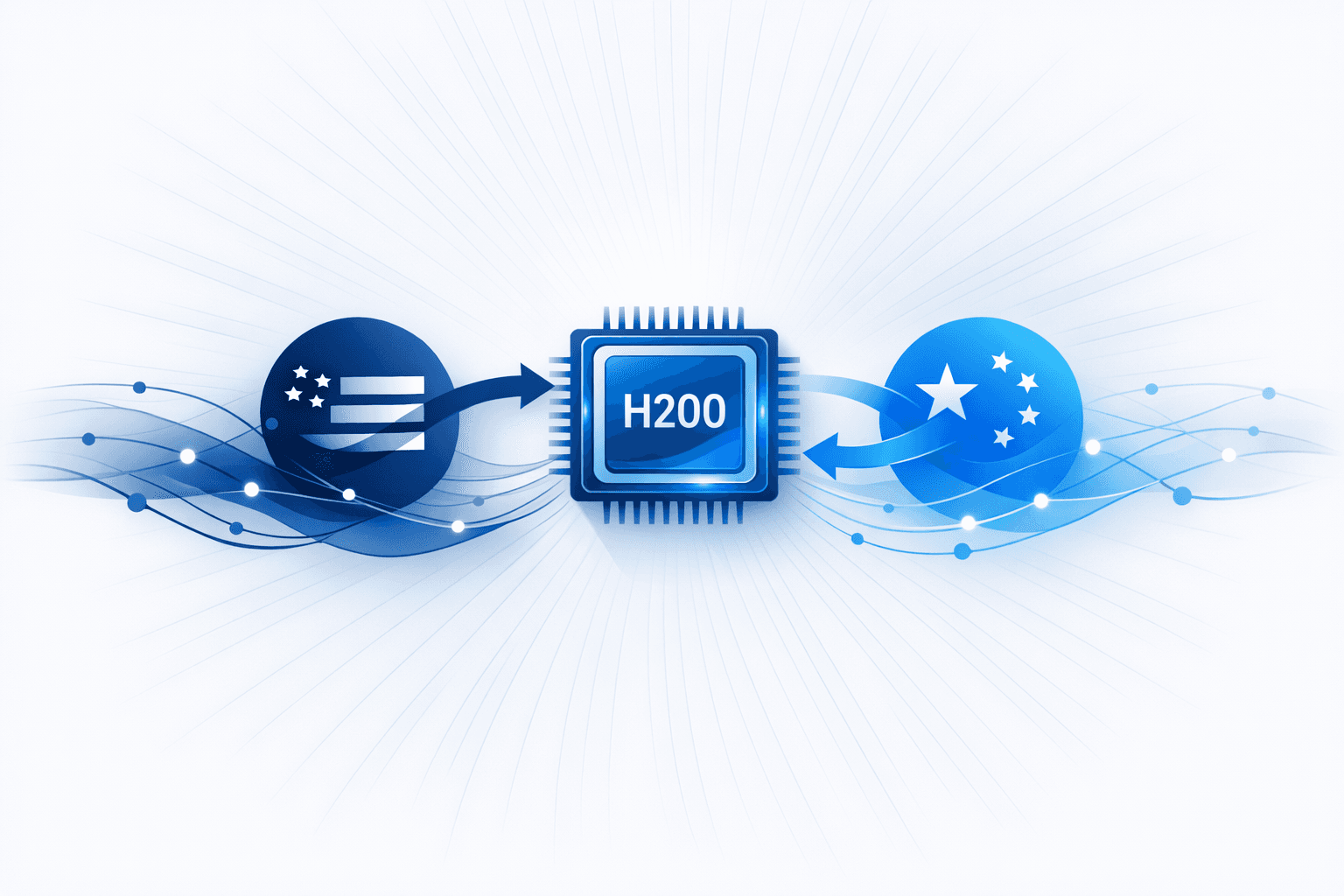
Nvidia has resumed movement of its China AI chip supply chain after receiving U.S. export licenses for multiple Chinese customers and restarting H200 manufacturing, according to CEO Jensen Huang. The restart follows a prolonged freeze caused by U.S. export controls designed to limit China’s access to advanced accelerators for military and strategic AI use. The new arrangement reportedly allows approved Chinese buyers to obtain H200 GPUs under federal authorization, with earlier reporting indicating a revenue-sharing surcharge tied to those sales. Demand from Chinese hyperscalers remains strong because the H200 is substantially more capable than the downgraded H20 product Nvidia had previously positioned for the market.
The policy shift is also affecting the broader semiconductor supply chain, especially South Korean memory suppliers tied to Nvidia’s AI products. Tight U.S. controls on high-end GPUs and even some mid-tier chips have increased uncertainty for companies such as SK Hynix and Samsung Electronics, whose high-bandwidth memory business is closely linked to Nvidia shipment volumes. At the same time, restrictions intended to slow Beijing’s AI progress are encouraging Chinese substitution efforts, with domestic alternatives such as Huawei Ascend 910B gaining traction as buyers seek to reduce dependence on U.S. technology.
Why it matters
Impact assessment
This is a geopolitical and supply-chain policy development, not a software vulnerability or active cyber intrusion. The primary affected parties are Nvidia, approved Chinese hyperscalers, and upstream semiconductor suppliers including SK Hynix and Samsung Electronics; downstream effects extend to AI infrastructure buyers and firms dependent on the CUDA ecosystem.
The impact is economically and strategically significant because limited H200 exports can reshape AI compute availability in China, influence memory demand, and affect long-term platform dependence between Nvidia CUDA and emerging Chinese alternatives such as Huawei Ascend 910B. Exposure is targeted and license-gated rather than widespread, and the story does not describe data loss, operational disruption from cyberattack, or exploitation in the wild.
Supporting facts
- Affected entities named: Nvidia, SK Hynix, Samsung Electronics, Huawei, ByteDance, Alibaba, Tencent, Baidu.
- Product focus: Nvidia H200 AI GPU, Nvidia H20, Huawei Ascend 910B.
- The U.S. shifted from stricter bans to conditional export licensing for some China-bound Nvidia H200 sales.
- Nvidia CEO Jensen Huang said Nvidia received export licenses for multiple Chinese customers, obtained purchase orders, and restarted H200 manufacturing.
- Chinese authorities reportedly approved ByteDance, Alibaba, and Tencent to buy more than 400,000 H200 units collectively.
- South Korean memory suppliers are exposed because HBM demand is tightly linked to Nvidia GPU shipment volume.
- The reporting states SK Hynix’s U.S.-based revenue rose to nearly 70 percent of total sales in August 2025, reflecting dependence on Nvidia-driven demand.
- The story frames a strategic risk that tighter controls may accelerate Chinese substitution and growth of a China-centered AI ecosystem.
- No ransomware, destructive activity, credential theft, or confirmed cyber exploitation incidents are described.