Mallory
← Back to News
phishing-campaign-intelligenceloader-delivery-mechanismremote-access-implantdefense-evasion-method

Phishing campaigns using Windows LNK files and PowerShell loaders to deliver RATs and ransomware

Social Engineering & Fraud · 3 sources · Updated 5mo ago · First seen Jan 27, 2026

Phishing campaigns using Windows LNK files and PowerShell loaders to deliver RATs and ransomware

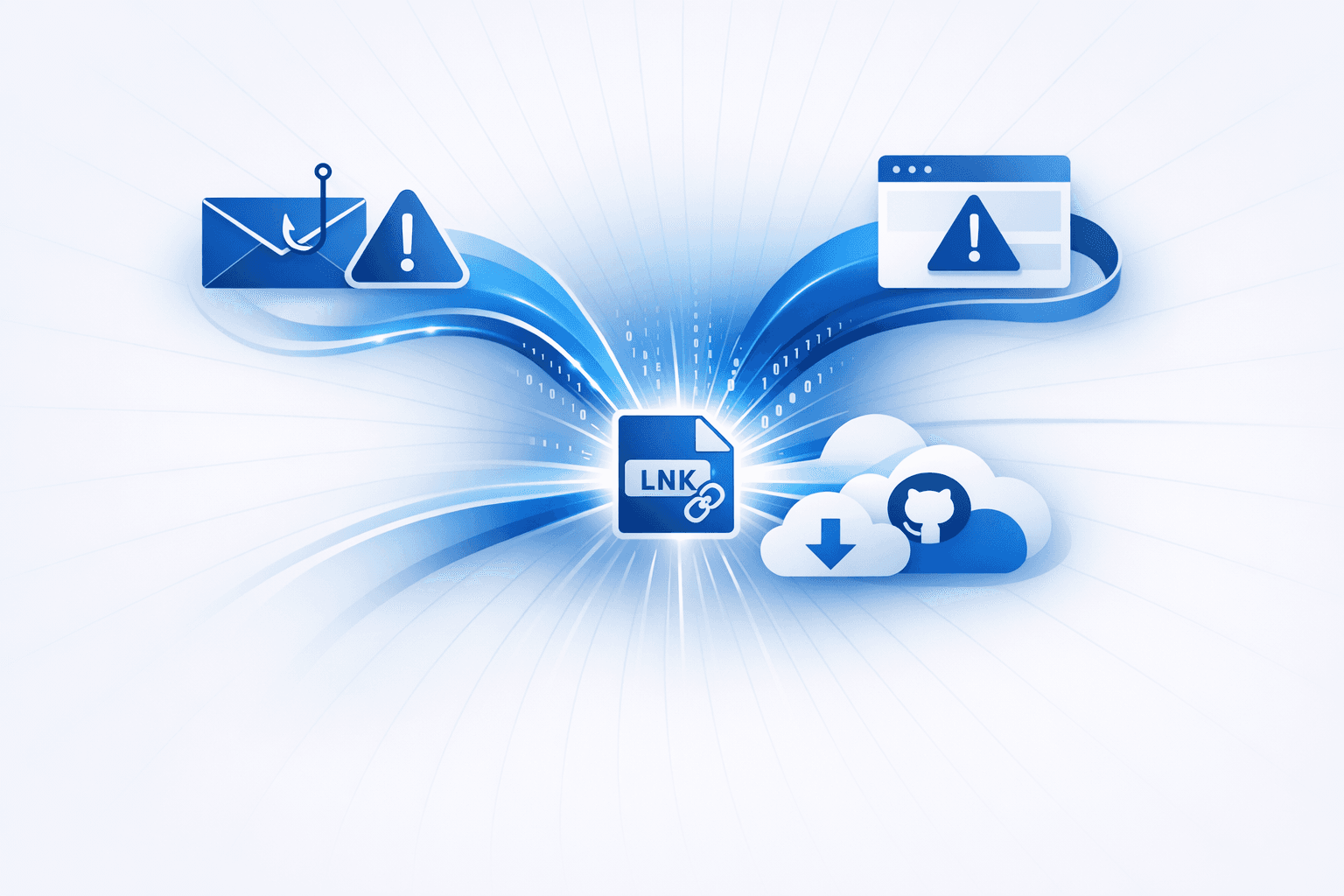
Multiple recent intrusion reports describe phishing-led Windows compromises that rely on weaponized .LNK shortcuts to trigger obfuscated PowerShell execution, display decoy documents, and then fetch additional payloads from public cloud/code platforms. In South Korea, attackers distributed an LNK disguised as financial trading guidance that opens a decoy PDF while running PowerShell; subsequent stages perform anti-analysis/virtualization checks, establish persistence, and retrieve a masked executable from GitHub that decrypts code at runtime to run MoonPeak malware. Researchers assessed the activity as likely North Korea–linked based on GitHub commit metadata and naming patterns.

A separate Russia-targeted campaign used business-themed archives containing decoy documents and a malicious LNK to pull a PowerShell loader that establishes persistence and then weakens defenses (including Microsoft Defender exclusion changes and use of defendnot), performs reconnaissance, and tampers with system tooling and file associations before deploying Amnesia RAT (fetched from Dropbox) and a Hakuna Matata–derived ransomware payload for encryption. By contrast, reporting on KazakRAT describes a different espionage operation in Kazakhstan/Afghanistan delivered via malicious MSI installers and using simple, unencrypted HTTP C2; it is not part of the LNK/PowerShell delivery chains described in the other incidents.

Why it matters

Impact assessment

These campaigns affect Windows users exposed to phishing, with observed targeting against users in Russia and South Korea. The impact is high because successful execution leads to full endpoint compromise, credential and wallet theft, surveillance, persistence, and in the Russia-focused activity, ransomware encryption and desktop lockout.

The scope appears targeted rather than indiscriminate, but the delivery methods rely on common Windows features and trusted public platforms, which increases enterprise exposure across sectors. There are reported intrusions in the wild: MoonPeak infections in South Korea and a Russia-targeted Amnesia RAT plus Hakuna Matata-derived ransomware campaign.

Supporting facts

  • Affected platforms: Windows endpoints.
  • Targeting observed: Russian users via business/accounting lures; South Korean users via financial trading guidance lures.
  • Delivery relies on phishing archives, malicious .LNK shortcut files, PowerShell loaders, and payload retrieval from GitHub and Dropbox.
  • Russia-targeted chain results in:
    • Amnesia RAT deployment for credential theft, session theft, screenshots, audio capture, remote commands, and exfiltration.
    • Hakuna Matata-derived ransomware encryption.
    • Ransom notes, wallpaper changes, process killing, WinLocker desktop blocking, and clipboard cryptocurrency address hijacking.
  • South Korea-targeted chain results in MoonPeak malware deployment with persistence and anti-analysis behavior.
  • No software vulnerability exploitation is required; compromise depends on user execution of malicious files and abuse of legitimate OS functionality and cloud services.

Is your org in this campaign?Get the infrastructure and lures behind it.
Hunt this campaign
Event timeline

How this story unfolded

Events from the most recent confirmed update back to the earliest known activity.

4 events · Jan 26, 2026
  1. Jan 26, 202610mo ago

    Amnesia RAT campaign escalates to ransomware and system lockout

    In the later stages of the Russia-targeted campaign, attackers deployed Amnesia RAT for credential, browser, wallet, and app data theft, then delivered a Hakuna Matata-derived ransomware payload. The malware encrypted files, dropped ransom notes, changed the wallpaper, and used a WinLocker component to block the desktop while also hijacking cryptocurrency clipboard addresses.

  2. Jan 26, 202610mo ago

    FortiGuard Labs reports Amnesia RAT phishing campaign targeting Russian users

    FortiGuard Labs disclosed a multi-stage phishing campaign aimed primarily at users in Russia that used business- or accounting-themed archive files containing malicious LNK shortcuts. The infection chain relied on PowerShell loaders, public services such as GitHub and Dropbox, and social engineering rather than software exploits to achieve full compromise.

  3. Jan 26, 202610mo ago

    Researchers link MoonPeak activity to North Korea–aligned actors

    Analysts assessed that the MoonPeak campaign was likely conducted by North Korea–linked threat actors based on GitHub commit email artifacts and file-naming patterns observed during the investigation.

  4. Jan 26, 202610mo ago

    MoonPeak malware intrusions target Windows systems in South Korea

    Researchers reported advanced intrusions compromising Windows systems in South Korea using malicious LNK files disguised as financial trading guidance. The shortcut displayed a decoy PDF while launching obfuscated PowerShell that established persistence, performed anti-analysis checks, and downloaded a GitHub-hosted MoonPeak payload.

Linked entities

Related entities

Vulnerabilities, threat actors, malware, products, organizations, and breaches Mallory has linked to this story.

Open in app →

Affected products

1 linked
Powershell
Do you run this?Get the infrastructure, lures, and IOCs behind this campaign, ready to push into your email and identity stack.
Hunt This Campaign
Mallory platform

See the full picture, correlated to your attack surface.

This page covers what’s public. Mallory adds the parts that aren’t: which of your assets are affected, which threat actors are using it right now, and what to deploy next.

Exposure mappingMap indicators from this story to your assets and identify affected systems in minutes.
Threat actor evidenceEvery observed campaign, victim, and pivot linked to actors named in this story.
Associated malwareMalware, exploits, and IOCs connected to the activity described here.
Detection signaturesYARA, Sigma, and Snort rules deployed to your SIEM as soon as they’re published.
Scheduled alertsGet matching new stories delivered to your team as they break, not the next morning.
AI threadsAsk questions about this story and take action on the answers.