Mallory
← Back to News
internet-facing-service-vulnerabilityopen-source-dependency-vulnerabilityactively-exploited-vulnerabilitygovernment-vulnerability-catalog

PHP2Shell Reports Warn of Server Takeovers and Trusted-Website Malware Delivery

Active Exploitation · 16 sources · Updated 2d ago · First seen Nov 20, 2026
PHP2Shell Reports Warn of Server Takeovers and Trusted-Website Malware Delivery

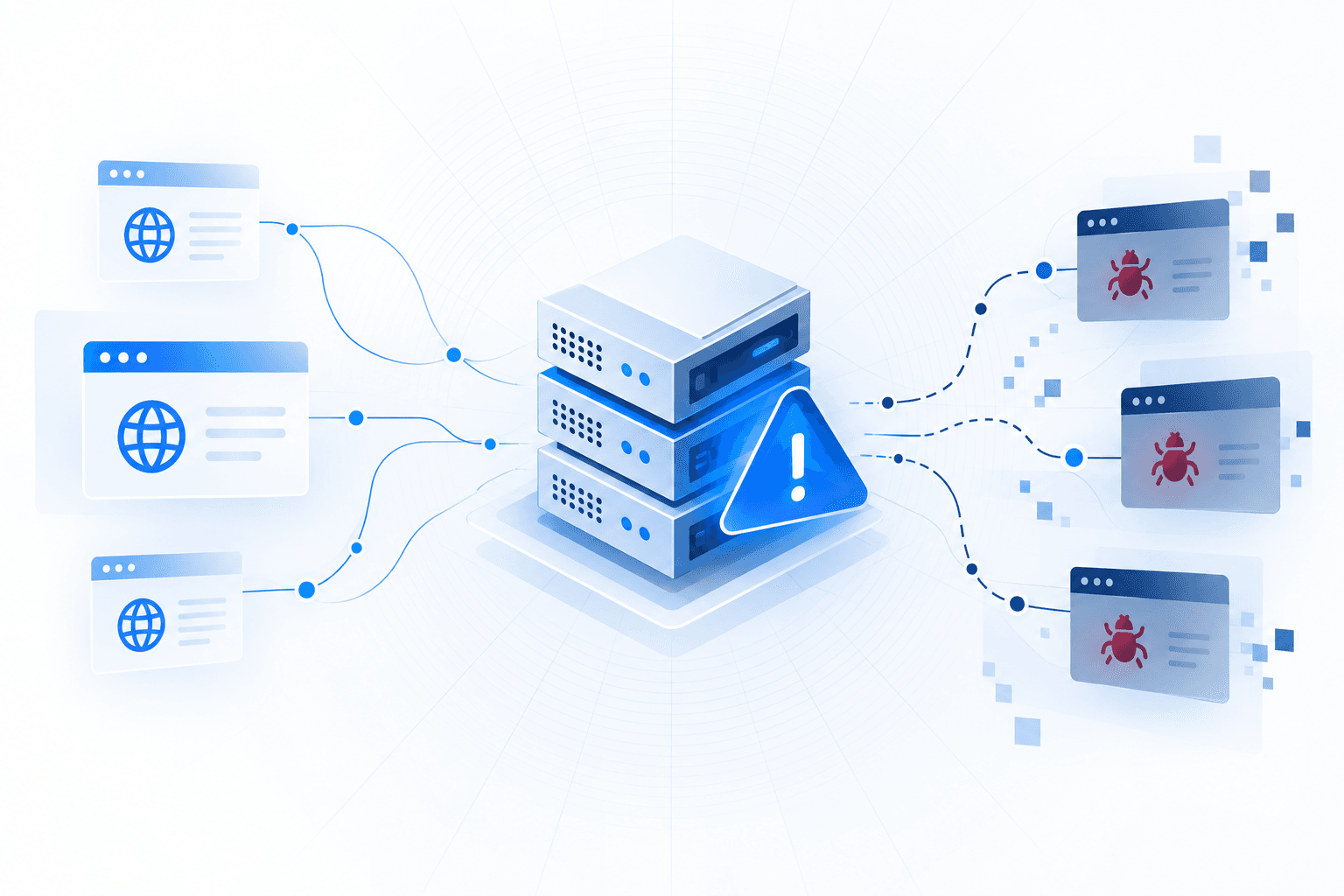
Two reported PHP vulnerabilities, CVE-2026-109618 and CVE-2026-109619, could enable unauthenticated remote code execution on web servers, according to Symantec and Tenable. Symantec says the flaws, collectively called PHP2Shell, affect PHP 5.4.0 and later and became public before patches were available. Tenable reports that PHP maintainers issued emergency patches on October 21, 2026, and that CISA subsequently added both vulnerabilities to its Known Exploited Vulnerabilities catalog with an October 29 federal civilian remediation deadline. These identifiers, scope and exploitation claims are not independently substantiated by the supplied evidence.

Tenable reports that attackers chained PHP2Shell with a Linux kernel vulnerability called Fragnesia to obtain root access, establish tunnels and pursue internal management systems and Active Directory credentials. Symantec warns that compromised trusted websites could also deliver malware and credential-theft lures to visitors; its examples involving Woodgnat, ClickFix and Jewelbug do not establish a connection to PHP2Shell. Recommended defensive priorities include comprehensive PHP asset inventories, verification of applicable PHP and kernel fixes against authoritative advisories, exploitation-informed remediation, restricted access from internet-facing systems to internal services, and predefined compensating controls for systems that cannot be patched immediately.

Why it matters

Assessment

PHP2Shell reportedly exposes vulnerable web-serving PHP deployments to unauthenticated command execution and sensitive worker-memory disclosure, creating risks of website takeover, credential theft, service interruption, and movement into internal systems. Reported exploitation includes a PHP2Shell–Fragnesia chain obtaining root access on 25 firewall and management servers; broad scanning and attack-request counts establish substantial activity, not a verified total of compromised organizations. The supplied sources report exploitation before disclosure, but authoritative CVE, PHP, and KEV records are not included for independent validation. SecureWorld, Tenable, AWS

  • Industry-specific impact: Government & Public Sector is specifically affected. Reporting identifies compromised systems in a U.S. government-affiliated environment, precautionary government website shutdowns, and an October 29 remediation obligation for federal civilian agencies under the reported BOD 26-04. Other organizations may be exposed, but the separate technology, financial-company, and government-tenant website-lure examples do not establish PHP2Shell victim sectors. Tenable, Symantec
  • Geography-specific impact: Reported compromised firewall and management servers were in the United States, Japan, Taiwan, and South Korea, including three systems in a U.S. government-affiliated environment. These are reported affected locations, not inferred locations from attacker infrastructure or vendor headquarters; the evidence does not imply exposure is exclusive to these countries. SentinelOne
  • Scope and severity: Tenable cites approximately 30.3 million services running affected PHP versions as of October 29, an exposure estimate rather than a victim count. Exploit tuning requirements can constrain broad automation, while identical appliance builds may enable reuse of a tuned exploit. Tenable
  • Downstream visitor risk: Compromised trusted websites could deliver malware or credential-theft lures without requiring a browser vulnerability. Woodgnat, ClickFix, and Jewelbug illustrate this general consequence but are not established as PHP2Shell-linked activity. Symantec

This is being exploited nowSee which actors are running it and whether you're in range.
Check your exposure
Event timeline

How this story unfolded

Events from the most recent confirmed update back to the earliest known activity.

19 events · Aug 11, 2026 – Nov 19, 2026
  1. Reported Nov 25, 20264d ago

    Nuclei fix proposed to detect PHP2Shell on end-of-life PHP branches

    A ProjectDiscovery nuclei-templates contribution proposed adding PHP 8.0 and 8.1 checks to the CVE-2026-109619 detector after it missed a PHP 8.0.30 host. Supplied test output showed the updated matcher detecting that version, but the reference does not establish that the correction was merged or released.

    fix(cve-2026-109619): match end-of-life PHP 8.0 and 8.1 branches by cikgufatah · Pull Request #18097 · projectdiscovery/nuclei-templates
  2. Reported Nov 21, 20267d ago

    Researcher reproduces PHP2Shell command execution in a PHP 8.4.26 Docker lab

    Abhilash H reported reproducing PHP2Shell using 9bie’s public proof of concept against PHP 8.4.26 with Apache prefork on x86_64, demonstrating command execution as www-data rather than root. The experiment combined an out-of-memory condition, a stale-identifier out-of-bounds read, and target-specific address calculations; it did not test whether patched PHP releases prevent exploitation.

    PHP2Shell: Practical RCE Reproduction in a Docker Lab | by Abhilash H | Nov, 2026 | InfoSec Write-ups
  3. Reported Nov 20, 20268d ago

    Tenable finds PHP2Shell exploits generally require target-specific tuning

    Tenable Research found that PHP2Shell exploitation generally required tuning for individual targets. Network appliances with identical builds could allow attackers to reuse a tuned exploit across exposed, unpatched devices.

    How the Public Sector Can Prepare for the Next PHP2Shell
  4. Reported Nov 20, 20268d ago

    Palo Alto Networks confirms PAN-OS exploitation and verifies reported tooling

    Palo Alto Networks confirmed exploitation of internet-exposed PAN-OS management interfaces. Its Unit 42 team said it independently verified the tooling and results reported by Dream Research.

    How the Public Sector Can Prepare for the Next PHP2Shell
  5. Reported Nov 20, 20268d ago

    Researchers report PHP2Shell–Fragnesia chain gaining root on 25 servers

    Dream Research reported that attackers chained PHP2Shell with Fragnesia to obtain root access on 25 servers, including firewalls at a U.S. government-affiliated organization. Attackers reportedly established a tunnel, reached a management server, and pursued Active Directory credentials.

    How the Public Sector Can Prepare for the Next PHP2Shell
  6. Reported Nov 20, 20268d ago

    PHP2Shell exploitation prompts organizations to take websites offline

    Attacks reportedly followed within days of disclosure and expanded to large-scale exploitation attempts. Organizations, including government agencies, temporarily took websites offline in response.

    How the Public Sector Can Prepare for the Next PHP2Shell
  7. Reported Nov 20, 20268d ago

    BreachForums and DarkForums take themselves offline after disclosure

    BreachForums and DarkForums reportedly went offline within hours of the PHP2Shell disclosure, likely to protect their PHP infrastructure.

    How the Public Sector Can Prepare for the Next PHP2Shell
  8. Reported Nov 20, 20268d ago

    Public proof of concept becomes available for Fragnesia

    A public proof of concept for the Linux kernel vulnerability Fragnesia, CVE-2026-46300, was available beginning in May. The flaw was subsequently reported as part of an attack chain involving PHP2Shell.

    How the Public Sector Can Prepare for the Next PHP2Shell
  9. Nov 19, 202610d ago

    PHP releases fixes for a separate critical runtime vulnerability

    PHP released versions 8.5.13, 8.4.28, 8.3.37, and 8.2.36 to address CVE-2026-115560, a separate critical runtime flaw whose exploitability depends on session-handling configuration and application libraries. No exploitation had been reported when the fixes were released.

    How the Public Sector Can Prepare for the Next PHP2Shell
  10. Oct 29, 20261mo ago

    Internet scanning identifies about 30.3 million affected PHP services

    Internet-wide scanning cited by Tenable identified approximately 30.3 million PHP services running affected versions as of October 29.

    How the Public Sector Can Prepare for the Next PHP2Shell
  11. Oct 28, 20261mo ago

    CISA adds Fragnesia to KEV and warns of PHP2Shell chaining

    CISA added CVE-2026-46300 to its Known Exploited Vulnerabilities catalog and warned that attackers could chain Fragnesia with PHP2Shell to implant PHP webshells.

    How the Public Sector Can Prepare for the Next PHP2Shell
  12. Oct 26, 20261mo ago

    CISA adds both PHP2Shell vulnerabilities to its KEV catalog

    CISA confirmed active exploitation and added both PHP2Shell vulnerabilities to its Known Exploited Vulnerabilities catalog. It set an October 29 remediation deadline for federal civilian agencies under Binding Operational Directive 26-04.

    How the Public Sector Can Prepare for the Next PHP2Shell
  13. Oct 23, 20261mo ago

    PHP publishes initial advisory and interim mitigation for CVE-2026-115560

    PHP published an informational advisory for CVE-2026-115560, describing an issue requiring an application to change session.serialize_handler at runtime. Pending a fix, PHP recommended setting session.upload_progress.enabled=0.

    PHP2Shell (CVE-2026-109618): Exploitation and Triage | Alpha Cyber
  14. Oct 21, 20261mo ago

    NSA urges immediate PHP2Shell updates or disconnection of exposed systems

    An NSA advisory urged organizations running PHP to update immediately and take systems offline if an immediate update was infeasible, until adequate mitigation was possible.

    Patch PHP Vulnerability Now or Take It Offline, NSA Warns
  15. Oct 21, 20261mo ago

    PHP maintainers release emergency PHP2Shell patches

    PHP maintainers released emergency fixes one day ahead of schedule following the leak. The fixes shipped in PHP 8.5.12, 8.4.27, 8.3.36, and 8.2.35.

    How the Public Sector Can Prepare for the Next PHP2Shell
  16. Oct 20, 20261mo ago

    PHP2Shell details leak before coordinated disclosure

    Details of CVE-2026-109618 and CVE-2026-109619 reportedly leaked before coordinated disclosure and before patches were available. The two PHP runtime vulnerabilities were described as enabling unauthenticated remote code execution.

    How the Public Sector Can Prepare for the Next PHP2Shell
  17. Oct 17, 20261mo ago

    Amazon detects PHP2Shell exploitation probes before disclosure and patches

    Amazon Threat Intelligence detected PHP2Shell exploitation probes against honeypots beginning October 17, 2026, four days before official patches were published. The report interprets the probes as evidence that attackers had obtained vulnerability details while the flaws remained under embargo.

    The Good, the Bad and the Ugly in Cybersecurity - Week 43 (2026)
  18. Reported Oct 13, 20262mo ago

    Shirudo documents sandbox mitigation for PHP2Shell post-exploitation

    Shirudo documented an app-sandbox upatch with Apache httpd and PHP-FPM policies that restrict PHP-file modification, execution of other programs, and outbound network access. The sandbox does not fix PHP2Shell or prevent attacker-controlled code from executing inside the application, so PHP upgrades remain necessary.

    shirudo/upatches/app-sandbox at main · shirudo-dev/shirudo · GitHub
  19. Aug 11, 20264mo ago

    Calif and OpenAI independently report PHP2Shell root cause to PHP

    Calif and OpenAI independently reported the underlying PHP2Shell memory-safety issue to the PHP security team on August 11, 2026. The discoveries involved AI-assisted auditing under OpenAI's Patch the Planet program.

    Stopping PHP2SHELL: How SentinelOne Protects Customers From This Attack Technique
Linked entities

Related entities

Vulnerabilities, threat actors, malware, products, organizations, and breaches Mallory has linked to this story.

Open in app →
Do you run this?Correlate live exploitation activity against the software you actually run, and see where you're exposed.
See Who's Exploiting This
Mallory platform

See the full picture, correlated to your attack surface.

This page covers what’s public. Mallory adds the parts that aren’t: which of your assets are affected, which threat actors are using it right now, and what to deploy next.

Exposure mappingMap indicators from this story to your assets and identify affected systems in minutes.
Threat actor evidenceEvery observed campaign, victim, and pivot linked to actors named in this story.
Associated malwareMalware, exploits, and IOCs connected to the activity described here.
Detection signaturesYARA, Sigma, and Snort rules deployed to your SIEM as soon as they’re published.
Scheduled alertsGet matching new stories delivered to your team as they break, not the next morning.
AI threadsAsk questions about this story and take action on the answers.