Mallory
← Back to News
phishing-campaign-intelligencecredential-access-methodinitial-access-method

Microsoft 365 AitM Attacks Hijack Sessions as Delayed Logs Complicate Response

Social Engineering & Fraud · 3 sources · Updated 9d ago · First seen Feb 26, 2025
Microsoft 365 AitM Attacks Hijack Sessions as Delayed Logs Complicate Response

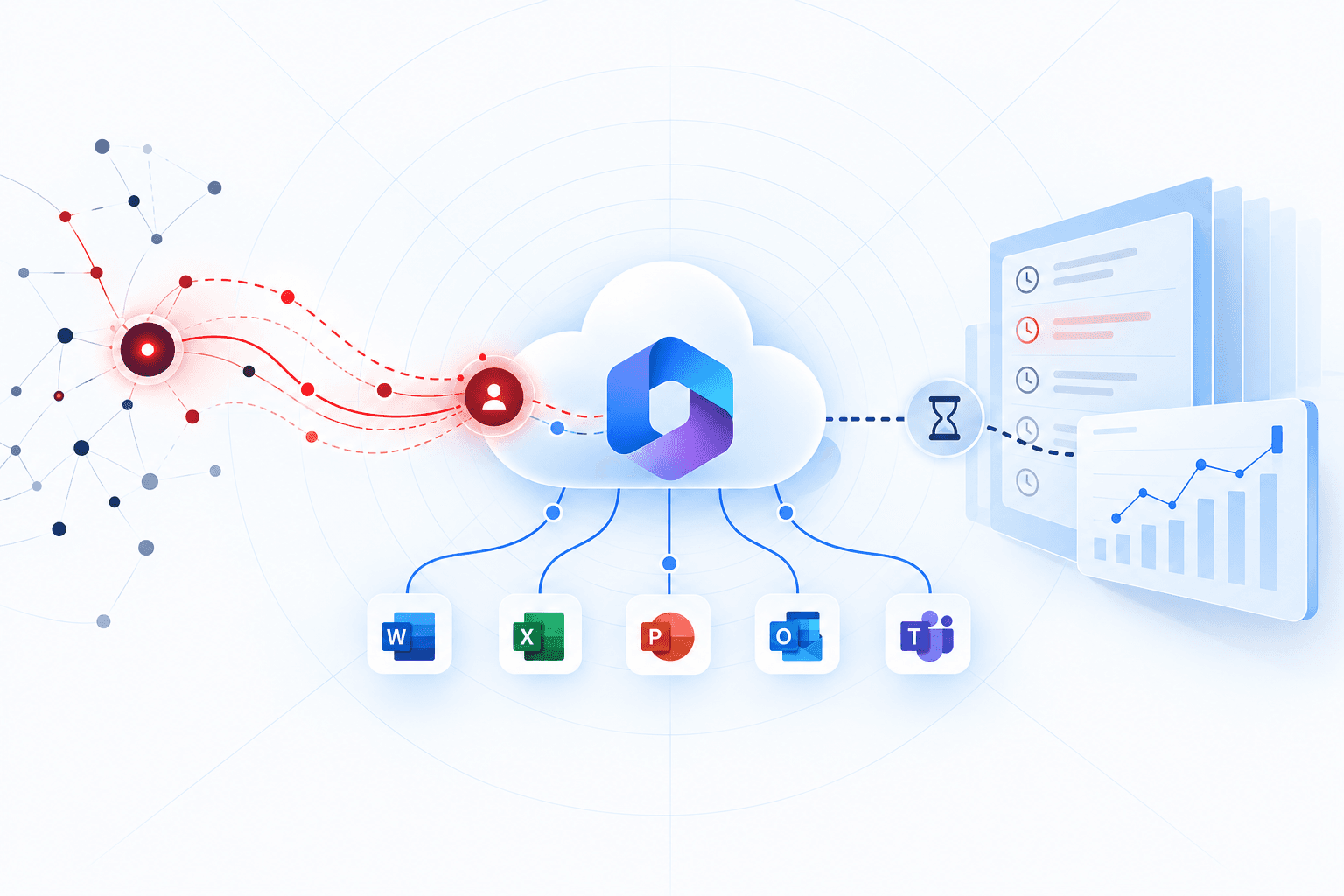
Adversary-in-the-middle (AitM) phishing is enabling rapid Microsoft 365 account takeovers, while delayed authentication logs can leave responders with incomplete evidence. Petra Security documented an attack that used a OneDrive document-sharing lure from a compromised, familiar collaborator to relay a user's password and two-factor authentication code, establishing an attacker session within 10 minutes. Defenders terminated access before any reported damage; the attacker then rotated proxy IP addresses and repeatedly failed to authenticate. In its analysis of a February 25, 2025, attack, Petra found that Microsoft published the successful sign-in roughly six minutes after access began, but the MFA-challenge event arrived about two hours later and an earlier incorrect-password event almost 20 hours later. Petra alerted within two seconds of ingesting the successful sign-in event.

Proofpoint's broader research found that 78% of Microsoft 365 tenants faced at least one HTTP-client-based account takeover attempt in the second half of 2024. Although most brute-force and password-spraying activity had low success rates, a targeted Axios-based AitM campaign stole credentials, MFA tokens, and session tokens, compromising 43% of targeted accounts and affecting more than 51% of targeted organizations between June and November. By comparison, a Node Fetch campaign generated over 13 million login attempts against more than 3,000 organizations but affected only 2% of those targeted. The findings support prioritizing phishing-resistant MFA, promptly revoking compromised sessions, correlating email, authentication, and audit records, and revisiting incident timelines as delayed telemetry arrives.

Why it matters

Microsoft 365 users face account takeover through adversary-in-the-middle (AitM) phishing that relays passwords and MFA codes, while delayed authentication telemetry can impede detection and incident reconstruction. Petra reported stopping one February 2025 intrusion before damage occurred; Proofpoint separately documented campaigns involving mailbox manipulation, data exfiltration, and OAuth persistence, with its targeted Axios campaign compromising 43% of targeted accounts and affecting over 51% of targeted organizations during June–November 2024. These are historical observations, not evidence of a new November 2026 campaign.

  • Industry-specific impact: Established through documented targeting of Industrials (transportation and construction), Financials (finance), Information Technology (IT), and Health Care (healthcare). Proofpoint also reported education-sector targeting, including student accounts, but the supplied evidence does not establish institutional ownership needed for a more specific sector-code assignment. These findings describe targeting, not uniform compromise across those industries. Proofpoint
  • Geography-specific impact is not established. The references do not identify victim countries; U.S., Russian, and Canadian proxy or hosting locations do not establish affected geographies.
  • Scope and severity: Proofpoint reported HTTP-client-based takeover attempts against 78% of Microsoft 365 tenants in its research during the second half of 2024. Its Node Fetch campaign generated over 13 million login attempts across more than 3,000 organizations but impacted only 2% of targeted organizations; these figures should not be conflated with the more successful, targeted Axios campaign. Successful compromise puts mailbox confidentiality, business communications, and financial workflows at risk.

Is your org in this campaign?Get the infrastructure and lures behind it.
Hunt this campaign
Event timeline

How this story unfolded

Events from the most recent confirmed update back to the earliest known activity.

16 events · Feb 2018 – Feb 26, 2025
  1. Reported Mar 12, 20252y ago

    Researchers observe a separate Microsoft Teams phishing lure

    Researchers reported observing a separate phishing lure delivered through Microsoft Teams during the week preceding their report.

    Multi-Stream Tracking an AitM Attack: From Lure to Lockout
  2. Reported Mar 12, 20252y ago

    Attacker changes proxy IP and repeatedly fails to authenticate

    After access was terminated, the attacker switched proxy IP addresses and repeatedly failed to authenticate using the session. Researchers assessed that the repeated attempts indicated an automated toolkit.

    Multi-Stream Tracking an AitM Attack: From Lure to Lockout
  3. Reported Mar 12, 20252y ago

    Defenders terminate attacker access before reported damage

    Defenders terminated the attacker's access after correlating Exchange messages, authentication events, and audit logs. Researchers reported that the authentication-code email supplied critical context for detecting the intrusion before damage occurred.

    Multi-Stream Tracking an AitM Attack: From Lure to Lockout
  4. Reported Mar 12, 20252y ago

    Attacker gains a legitimate session after relaying password and MFA code

    Suspicious sign-ins appeared less than a minute after the authentication-code email and less than 10 minutes after the document was shared. Researchers interpreted the authentication sequence as evidence that the attacker relayed both the password and MFA code, obtaining a legitimate session through infrastructure associated with Global Internet Solutions LLC.

    Multi-Stream Tracking an AitM Attack: From Lure to Lockout
  5. Reported Mar 12, 20252y ago

    Compromised collaborator sends a OneDrive phishing lure

    A Microsoft 365 user received a OneDrive document-sharing lure from a compromised collaborator with whom they had previously worked and exchanged email. Seconds later, the user received an authentication-code email, which researchers interpreted as evidence that the user's password had been relayed to Microsoft.

    Multi-Stream Tracking an AitM Attack: From Lure to Lockout
  6. Feb 26, 20252y ago

    Incorrect-password event arrives almost 20 hours after the attack

    The InvalidUserNameOrPassword event arrived almost 20 hours after the February 25 evening attack. Its arrival completed an authentication sequence whose records had been delivered out of chronological order.

    Microsoft Logs Missing for Hours After Attack
  7. Feb 25, 20252y ago

    Microsoft emits the missing MFA-challenge event two hours after the attack

    Microsoft's API emitted the UserStrongAuthClientAuthNRequiredInterrupt event approximately two hours after the attack. The delayed event documented the MFA challenge that preceded the successful sign-in.

    Microsoft Logs Missing for Hours After Attack
  8. Feb 25, 20252y ago

    Delayed successful sign-in record triggers Petra alert

    Microsoft published the successful sign-in record approximately six minutes after the attacker gained access. Petra ingested it 24 seconds later and alerted two seconds afterward, but the available telemetry omitted the preceding unsuccessful authentication activity.

    Microsoft Logs Missing for Hours After Attack
  9. Feb 25, 20252y ago

    Attacker completes Microsoft 365 authentication through an AitM attack

    On February 25, an attacker submitted an incorrect password at 6:34:50 PM, supplied the correct password at 6:36:01 PM, and completed the MFA challenge at 6:36:35 PM. The sequence established access to the targeted Microsoft 365 account.

    Microsoft Logs Missing for Hours After Attack
  10. Reported Jan 29, 20252y ago

    Axios campaign shifts exclusively to Russia-based proxies

    The Axios campaign initially used several U.S.-based proxy services before switching to Russia-based proxies exclusively.

    HTTP Client Tools Exploitation for Account Takeover Attacks | Proofpoint US
  11. Reported Jan 29, 20252y ago

    Proofpoint reveals extensive compromises in Axios-based AitM campaign

    Proofpoint reported that the Axios campaign compromised 43% of targeted user accounts and affected over 51% of targeted organizations between June and November 2024. Observed post-compromise activity included mailbox-rule creation, data exfiltration, and malicious OAuth application registration for persistence.

    HTTP Client Tools Exploitation for Account Takeover Attacks | Proofpoint US
  12. Oct 2024

    Go Resty attacks cease while Node Fetch activity continues

    The observed Go Resty-based attacks stopped in October 2024. The related Node Fetch password-spraying campaign continued.

    HTTP Client Tools Exploitation for Account Takeover Attacks | Proofpoint US
  13. Aug 2024

    Related Go Resty brute-force wave begins

    Proofpoint observed a Go Resty-based brute-force wave using the same operational infrastructure as the Node Fetch campaign. Both activities simultaneously targeted the same organizations.

    HTTP Client Tools Exploitation for Account Takeover Attacks | Proofpoint US
  14. Jun 9, 20242y ago

    Large Node Fetch password-spraying campaign begins

    A Node Fetch-based campaign began targeting Microsoft 365 accounts, primarily in education. Proofpoint subsequently recorded more than 13 million login attempts against over 178,000 accounts across more than 3,000 organizations, with successful compromises affecting 2% of targeted organizations.

    HTTP Client Tools Exploitation for Account Takeover Attacks | Proofpoint US
  15. Jun 4, 20242y ago

    Axios-based account takeover campaign reaches targeting peak

    The Axios-based campaign targeted 175 users on June 4, 2024, its observed daily peak. Proofpoint assessed that the campaign used adversary-in-the-middle techniques to steal credentials, MFA tokens, and session tokens.

    HTTP Client Tools Exploitation for Account Takeover Attacks | Proofpoint US
  16. Feb 2018

    OkHttp-based Microsoft 365 takeover campaign identified

    A campaign first identified in February 2018 targeted high-value Microsoft 365 users worldwide. It persisted for nearly four years using hosting infrastructure in Canada and the United States.

    HTTP Client Tools Exploitation for Account Takeover Attacks | Proofpoint US
Linked entities

Related entities

Vulnerabilities, threat actors, malware, products, organizations, breaches, and observables Mallory has linked to this story. Indicator values are masked here and available in full in the app.

Open in app →

Affected products

2 linked
Microsoft OfficeMicrosoft 365

Organizations

1 linked
Microsoft Corporation

Observables

6 linked

Indicator values are masked on this page. See the values in Mallory Domains, IPs, hashes, and URLs are exportable to your SIEM.

Do you run this?Get the infrastructure, lures, and IOCs behind this campaign, ready to push into your email and identity stack.
Hunt This Campaign
Mallory platform

See the full picture, correlated to your attack surface.

This page covers what’s public. Mallory adds the parts that aren’t: which of your assets are affected, which threat actors are using it right now, and what to deploy next.

Exposure mappingMap indicators from this story to your assets and identify affected systems in minutes.
Threat actor evidenceEvery observed campaign, victim, and pivot linked to actors named in this story.
Associated malwareMalware, exploits, and IOCs connected to the activity described here.
Detection signaturesYARA, Sigma, and Snort rules deployed to your SIEM as soon as they’re published.
Scheduled alertsGet matching new stories delivered to your team as they break, not the next morning.
AI threadsAsk questions about this story and take action on the answers.