
Loading story…
Attackers abused the WinRAR remote code execution flaw CVE-2023-38831 in spear-phishing campaigns that used crafted RAR archives to trigger malware execution when victims opened a decoy document. In one case, a phishing email impersonating a consultant from Russia’s Ministry of Industry and Trade targeted a major Russian semiconductor supplier and delivered the Athena agent from the Mythic C2 framework. The archive paired a benign PDF with a malicious script disguised through the trailing-space filename trick tied to the WinRAR flaw; execution led to a PowerShell downloader, retrieval of a decoy PDF and payload from 45.142.212.34, persistence via a scheduled task named aimp2, and command-and-control over Discord-backed channels.
Ukraine’s CERT-UA separately reported active exploitation of the same vulnerability by UAC-0057, which used a malicious archive named Збірник_тез_НУОУ_23.rar to launch a chain involving a BAT file, an LNK shortcut, mshta.exe, and an embedded HTA file. That intrusion dropped a decoy PDF, executed JavaScript identified as a PicassoLoader variant, downloaded an SVG containing an encrypted .NET payload, decrypted it with the Rabbit algorithm, and ultimately deployed Cobalt Strike Beacon. The reports indicate that public proof-of-concept code and broad post-disclosure abuse have made CVE-2023-38831 a practical delivery vector for multiple malware families and threat actors.

See which actors are running it and whether you're in range.
9 events from the most recent confirmed update back to the earliest known activity.
In the same August 31 advisory, CERT-UA warned that CVE-2023-38831 was being actively exploited and noted that public proof-of-concept code existed for generating malicious archives. The agency also published host and network indicators tied to the campaign.
CERT-UA disclosed a cyberattack by UAC-0057 using a malicious archive named "Збірник_тез_НУОУ_23.rar" to exploit CVE-2023-38831. The infection chain used a BAT file, LNK shortcut, mshta, JavaScript, and an SVG-hosted encrypted .NET payload that ultimately deployed Cobalt Strike Beacon.
Group-IB reported DarkMe malware exploiting CVE-2023-38831 and also observed GuLoader and Remcos RAT using the same exploit path. This showed the vulnerability was being adopted by multiple malware operators.
The domains topibuzz.space and windacarmelita.pw, later tied to a CERT-UA-described exploitation campaign, were registered through publicdomainregistry.com. CERT-UA linked them to payload delivery and related network activity.
RARLAB released WinRAR 6.23 to remediate CVE-2023-38831. The fixed version addressed the code execution issue exploited through specially crafted archives.
Artifacts later published by CERT-UA show Beacon-related malware components compiled in late August 2023, including regsvr.dll on August 21 and mokpp9342jktihh.dll on August 29. These timestamps indicate preparation of the payloads used in the campaign.
RARLAB issued a beta patch to address CVE-2023-38831 after the vulnerability was discovered. This was the first cited vendor fix for the WinRAR flaw.
Group-IB discovered the underlying WinRAR ZIP-processing vulnerability CVE-2023-38831. The flaw affects WinRAR versions before 6.23 and can lead to arbitrary code execution via a crafted archive.
Cyble Research and Intelligence Labs identified a spear-phishing campaign targeting a leading Russian semiconductor supplier. The email spoofed a consultant from Russia’s Ministry of Industry and Trade and used a crafted archive named "resultati_sovehchaniya_11_09_2023.rar" to exploit CVE-2023-38831 and deliver the Athena agent of the Mythic C2 framework.
Vulnerabilities, threat actors, malware, products, organizations, breaches, and observables Mallory has linked to this story. Indicator values are masked here and available in full in the app.
Indicator values are masked on this page. View all 40 in Mallory Domains, IPs, hashes, and URLs are exportable to your SIEM.
Correlate live exploitation activity against the software you actually run, and see where you're exposed.
4 references tracked. Mallory keeps watching after this page renders.
Map indicators from this story to your assets and identify affected systems in minutes.
Every observed campaign, victim, and pivot linked to actors named in this story.
Malware, exploits, and IOCs connected to the activity described here.
YARA, Sigma, and Snort rules deployed to your SIEM as soon as they’re published.
Get matching new stories delivered to your team as they break — not the next morning.
Ask questions about this story and take action on the answers.
Other stories Mallory is tracking that overlap on entities, sources, or topic labels.
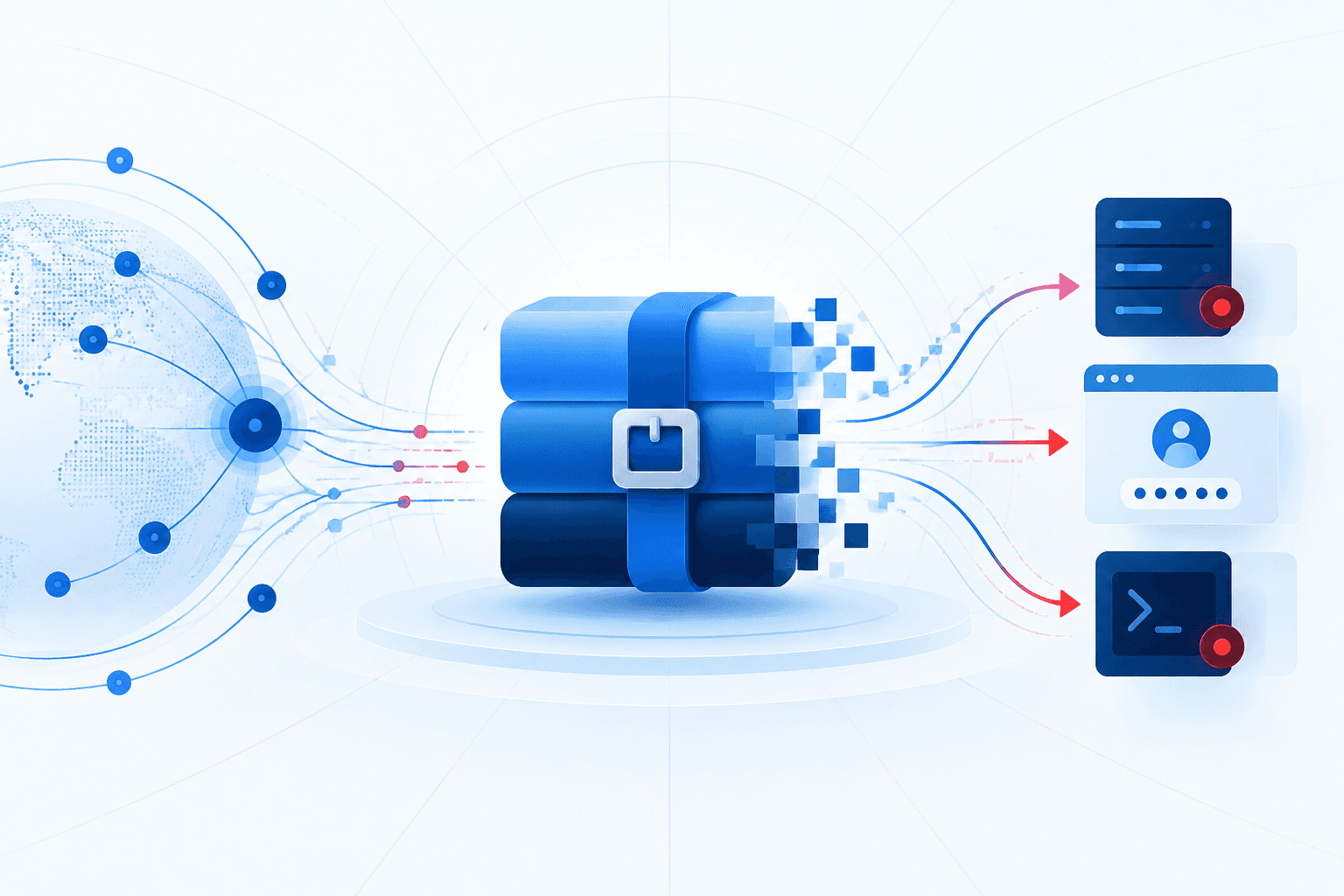
Multiple threat groups exploited **CVE-2023-38831**, an arbitrary code execution vulnerability in WinRAR versions before **6.23**, in campaigns reported during 2023. The flaw lets a specially crafted archive execute malicious code when a user opens an apparently harmless file inside it. Reported actors included DarkPink, Konni, SideCopy, APT29, UAC-0057, APT28, Sandworm, and APT40. Targets spanned government, defense, energy, financial trading, and cryptocurrency interests across Ukraine, Europe, India, Papua New Guinea, Vietnam, and Malaysia. Attackers combined phishing and decoy documents with malicious scripts, DLL side-loading, and staged loaders to deliver backdoors, remote access Trojans, and information stealers, including DarkMe, Remcos, PicassoLoader, Rhadamanthys, and BOXRAT. **Updating WinRAR to version 6.23 or later addresses the vulnerability.** Defenders should identify outdated installations and investigate suspicious archive-opening activity using the published indicators of compromise, behavioral hunting guidance, and archive-focused YARA detection provided in the reports.
Oct 9, 2026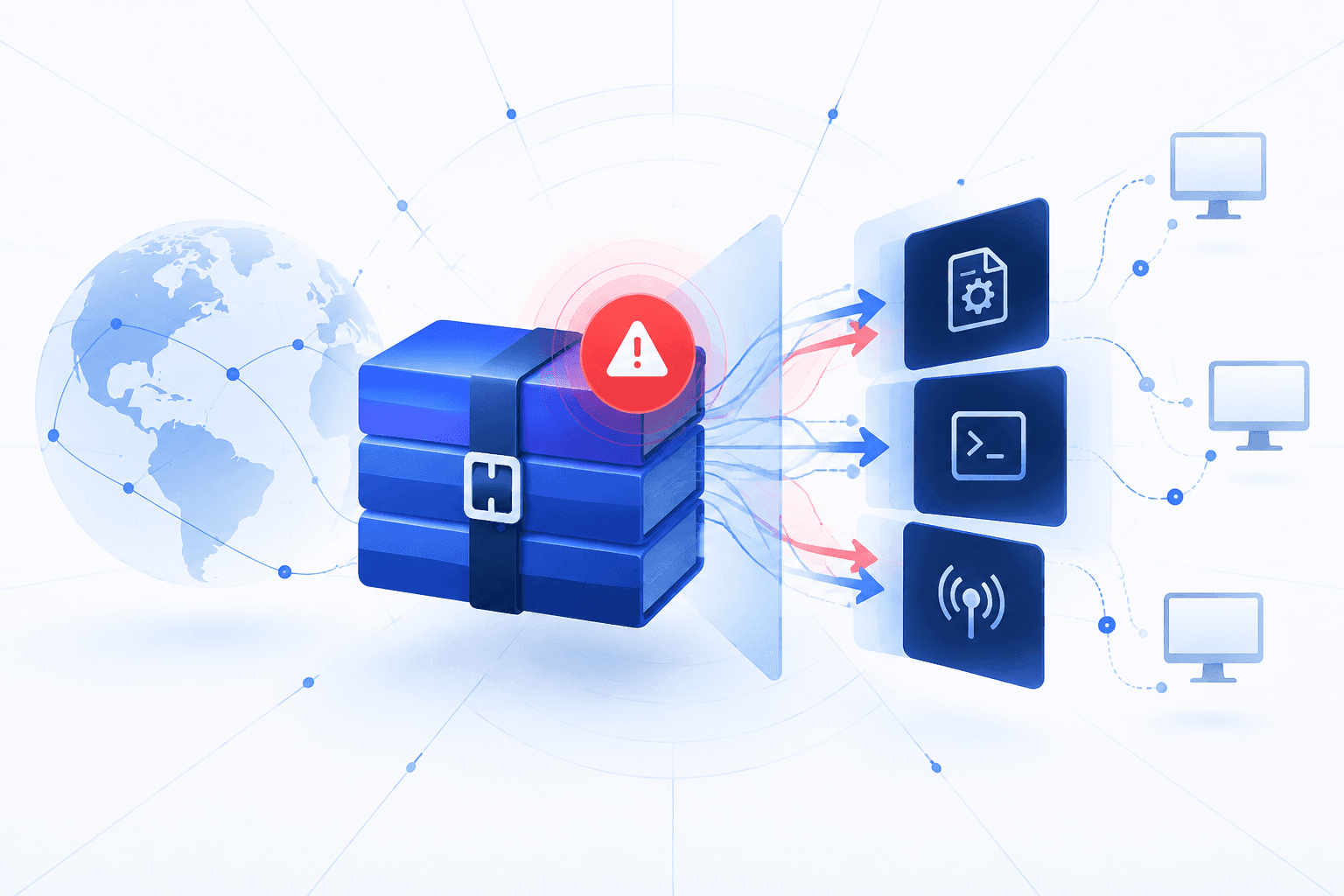
Attackers are exploiting **CVE-2025-8088**, a path traversal vulnerability affecting WinRAR versions earlier than **7.13**, to gain initial access through malicious RAR archives delivered by spear-phishing. Crafted archives write payloads outside the intended extraction directory, potentially enabling arbitrary code execution through shortcuts or other launch mechanisms. Italy’s CSIRT reported active exploitation in August 2025, following RARLAB’s July 30 patch release, and noted that a public proof-of-concept exploit was available. Threat Landscape subsequently reported multiple unnamed intrusion sets using the flaw to deploy **Amaranth Loader**, with follow-on tooling including the Havoc framework and a Telegram-controlled remote access trojan. The campaigns conceal payloads using Alternate Data Streams and employ HTTPS, commercial CDN fronting, geofencing, and short-lived domains to reduce exposure to scanning and sandbox analysis. Continued exploitation despite the available fix makes updating all vulnerable WinRAR installations to version 7.13 or later a priority; defenders should also investigate suspicious archive extraction, unexpected file writes, and shortcut-triggered execution.
Oct 9, 2026
Researchers attributed a January 2026 cyberespionage campaign against Ukrainian government, military, and critical infrastructure organizations to the Russia-linked Gamaredon group, which used booby-trapped spearphishing attachments and malicious RAR archives exploiting WinRAR path traversal flaw **`CVE-2025-8088`** for initial access. The infection chain dropped an HTA payload dubbed **GammaPhish**, which launched via `mshta.exe` and fetched follow-on VBScript components including **GammaLoad**, **GammaWorm**, and **GammaSteel**. Sekoia said the operation marks a shift from Gamaredon’s older Pteranodon tooling to a fragmented, modular ecosystem in which multiple stages can independently act as backdoors and retrieve arbitrary remote code. The malware emphasized stealth, persistence, and resilient command-and-control. **GammaWorm** established persistence through scheduled tasks and RunOnce registry keys, hid modules in **NTFS Alternate Data Streams**, and spread through USB devices and network shares using malicious LNK shortcuts, including into air-gapped environments. Command-and-control discovery relied on dead-drop resolvers hosted on **Telegram**, **Telegra.ph**, **graph.org**, **Teletype**, **Cloudflare Workers**, and operator infrastructure, while **GammaSteel** staged dozens of DPAPI-encrypted modules in the registry and exfiltrated selected files to **AWS S3** or other S3-compatible storage with fallback to attacker-controlled servers. Because fresh payloads can be fetched at multiple stages, researchers warned that confirmed compromises may require full system wiping.
Jun 29, 2026