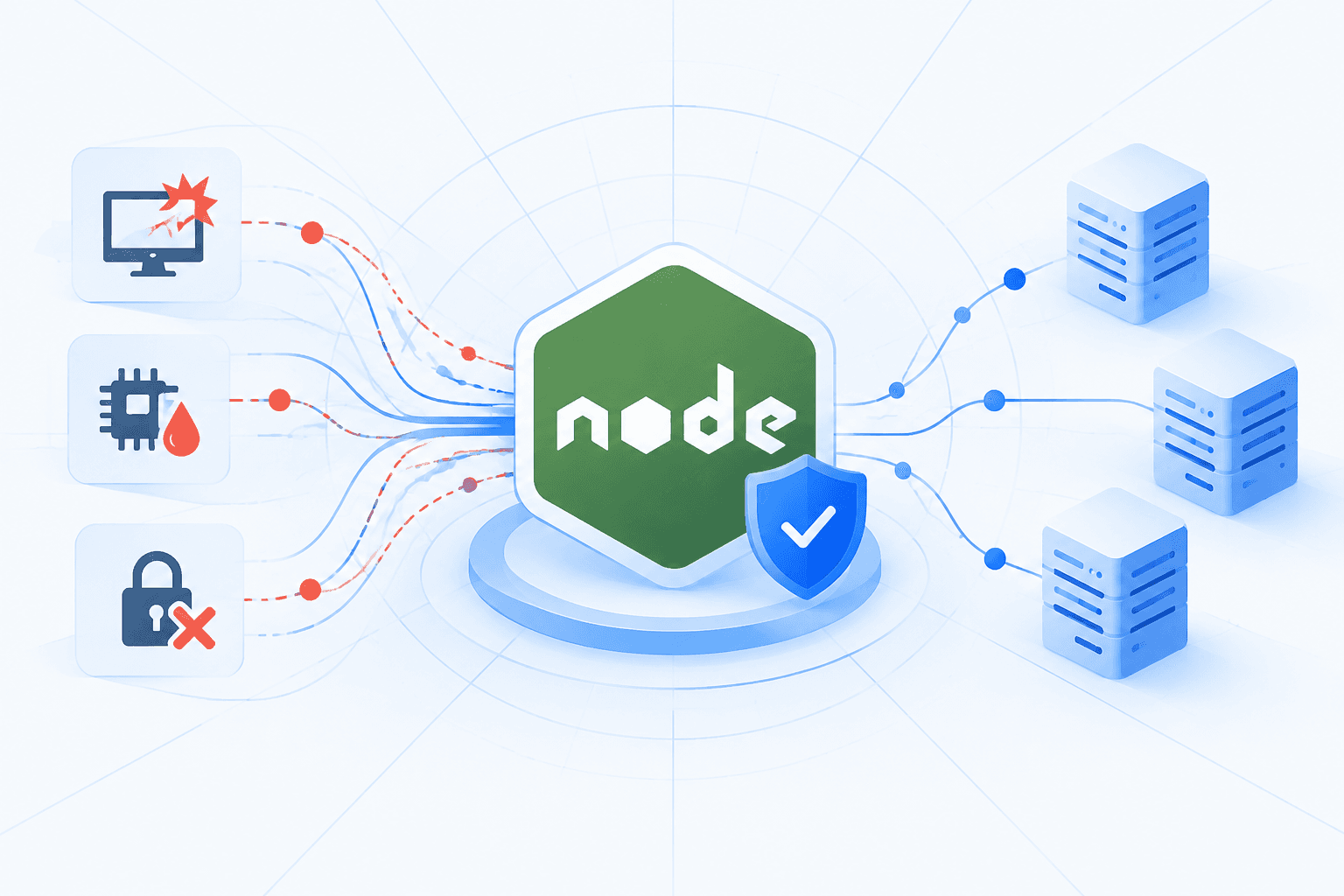
Node.js patches high-severity DoS flaws in TLS and HTTP request handling
Patch & Detection Intelligence · 10 sources · Updated 4mo ago · First seen Mar 18, 2026

Node.js released security updates for supported 20.x, 22.x, 24.x, and 25.x branches to fix two high-severity, five medium-severity, and two low-severity vulnerabilities, with patched versions issued as v20.20.2, v22.22.2, v24.14.1, and v25.8.2. The most serious bug, CVE-2026-21637, was an incomplete fix in TLS SNICallback handling that could be triggered remotely to cause an uncaught exception and crash affected processes. A second high-severity issue, CVE-2026-21710, allowed specially crafted HTTP requests using a __proto__ header name to trigger a denial of service when applications accessed req.headersDistinct.
The release also addressed Permission Model bypasses, a native crash in URL formatting, a timing side-channel in HMAC verification, an HTTP/2 flow-control memory leak that could lead to memory exhaustion, and a V8 HashDoS weakness; Node.js also updated the undici dependency on 22.x, 24.x, and 25.x to remediate public vulnerabilities. Debian published a corresponding nodejs security update, and the Canadian Centre for Cyber Security urged administrators to review vendor guidance and apply the patched releases, with internet-facing TLS servers identified as the highest-priority systems for remediation.
Why it matters
Impact assessment
Node.js deployments on supported 20.x, 22.x, 24.x, and 25.x branches are affected, with the highest operational risk concentrated in internet-facing TLS and HTTP/2 services and any HTTP servers that expose request parsing to untrusted clients. The primary impact is denial of service through remotely triggerable process crashes or memory exhaustion, with additional lower-probability risks including permission model bypasses, timing leakage, and performance degradation.
Exposure is broad because the flaws affect all supported release lines rather than a niche feature set, although some issues require specific application behavior such as use of req.headersDistinct, HTTP/2 enablement, or the experimental Permission Model. The provided references do not report confirmed exploitation in the wild, but multiple bugs are remotely reachable without authentication and should be treated as patch-now issues for exposed services.
Affected populations
- Organizations running Node.js 20.x, 22.x, 24.x, or 25.x
- Internet-facing TLS servers using
SNICallback - Node.js HTTP servers that access
req.headersDistinct - Node.js HTTP/2 services
- Applications processing attacker-controlled JSON or large untrusted object keys
- Environments using the experimental Node.js Permission Model
- Debian systems consuming the
nodejspackage
Severity and business effect
- High-severity remote DoS risk from
CVE-2026-21637 - High-severity remote DoS risk from
CVE-2026-21710 - Medium-severity resource exhaustion risk from
CVE-2026-21714 - Medium-severity performance degradation risk from
CVE-2026-21717 - Medium/low-severity confidentiality and policy-enforcement impact from permission model bypasses and HMAC timing leakage
- Likely business outcomes: service interruption, degraded availability, incident response overhead, and reputational impact for public-facing applications
Scope and exploitation status
- Scope is widespread across supported Node.js branches
- Highest urgency applies to public-facing services reachable over TLS, HTTP, or HTTP/2
- No explicit in-the-wild exploitation was cited in the references