AI-driven security and governance challenges across enterprises and government
Emerging Technology Risk · 5 sources · Updated 5mo ago · First seen Mar 3, 2026
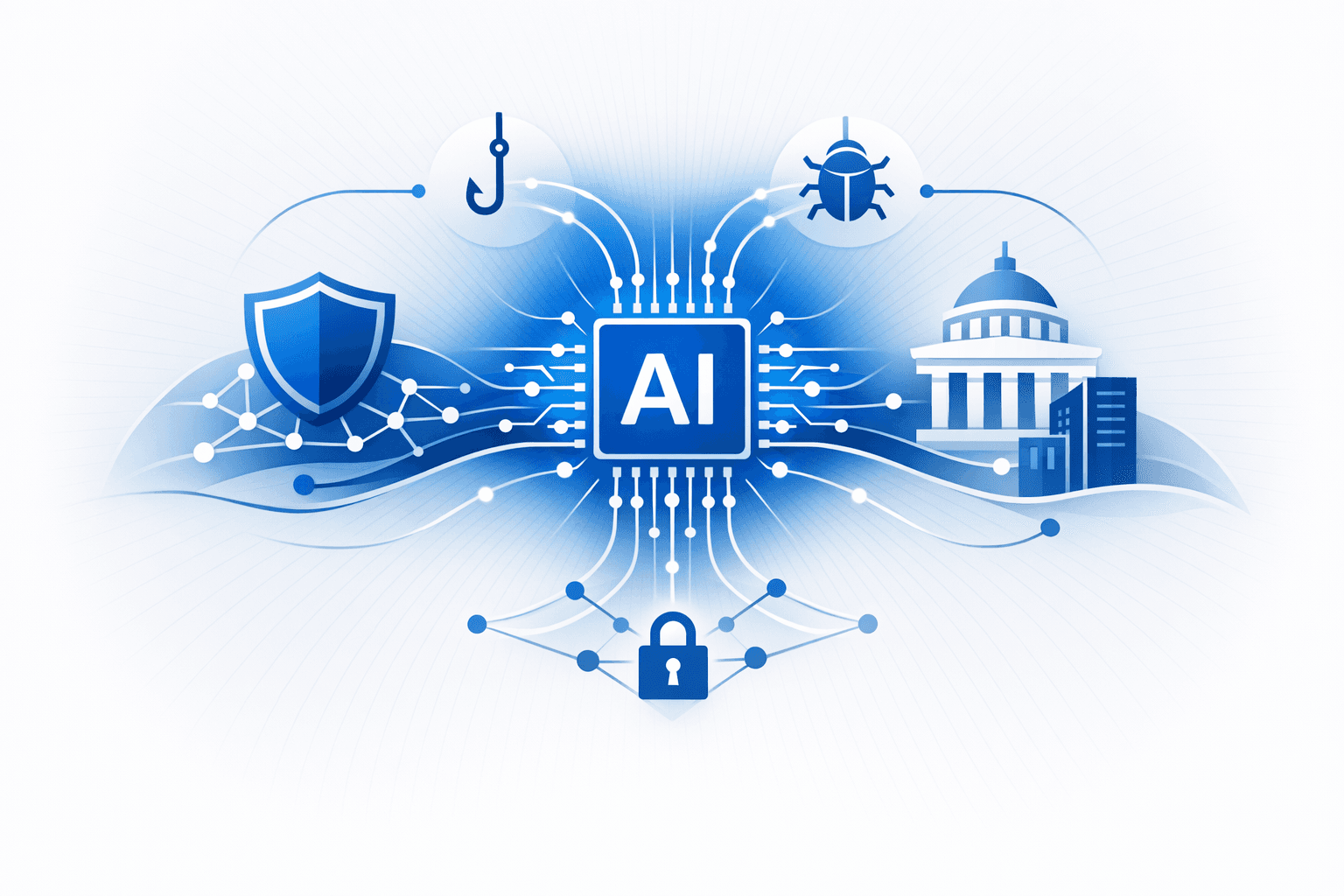
Public- and private-sector security leaders are increasingly treating AI adoption as inseparable from cybersecurity, citing governance, workforce, and operational impacts. U.S. government-focused commentary argues agencies must build “cyber-AI” capability across education pipelines and critical infrastructure, as AI simultaneously improves detection/response and enables faster phishing, malware development, and adaptive attacks. Enterprise security coverage echoes the governance challenge: attempts to ban AI-enabled browsers are expected to drive “shadow AI” usage, with concerns including sensitive-data leakage to third parties and prompt-injection risks; separate reporting highlights friction between developers and security teams as AI-accelerated delivery increases firewall rule backlogs and delays, pressuring organizations to automate controls without weakening oversight.
Threat and risk reporting also points to concrete shifts in attacker tradecraft and defensive tooling. Cloudflare’s Cloudforce One threat report describes infostealers (e.g., LummaC2) stealing live session tokens to bypass MFA, heavy automation in credential abuse (bots dominating login attempts), and a ransomware initial-access pipeline increasingly tied to infostealer activity; it also notes a coordinated disruption effort against LummaC2 infrastructure and expectations of successor variants that compress time-to-ransomware. In parallel, AppSec commentary describes Anthropic’s Claude Code Security as a reasoning-based code scanning and patch-suggestion capability that claims to identify large numbers of previously unknown high-severity issues, but still requires human approval and does not replace production AppSec programs; other items in the set are largely non-incident thought leadership (skills gap, secure-by-design, AI security “tactics,” and workforce resilience), plus unrelated content (awards, job listings, quantum-resistant data diode product coverage, and an AI nuclear wargame study).
Why it matters
Impact assessment
AI adoption is creating broad enterprise and government security exposure, but this story is primarily a strategic risk update rather than a single incident. The most immediate operational impact comes from infostealer-driven session theft, automated credential abuse, phishing/BEC enablement, and governance gaps around AI tools that can lead to sensitive-data leakage, reduced visibility, and faster attacker dwell-to-impact timelines.
Summary
Public-sector agencies, large enterprises, and SMBs are affected across identity, browser, cloud, email, and application-security workflows. Severity is high where organizations rely on browser-based AI tools, cloud-delivered apps, and MFA as a primary control, because stolen session tokens and shadow AI usage can bypass existing safeguards. Exposure is widespread rather than narrowly targeted, and the Cloudflare reporting cites active attacker tradecraft and prior real-world disruption operations against LummaC2 infrastructure.
Supporting details
- Affected sectors and populations:
- U.S. federal agencies and critical infrastructure operators adopting AI into operations and defense.
- Enterprises with browser-centric SaaS usage, remote work, BYOD, and GenAI browser extensions.
- Organizations exposed to credential theft, phishing, BEC, ransomware, and cloud/SaaS abuse.
- Development and security teams operating cloud, hybrid, and multi-cloud environments with firewall change backlogs.
- Severity drivers:
- Sensitive-data leakage to third-party AI services through browser sidebars and extensions.
- Prompt-injection risk in AI-enabled browsers that can manipulate browser behavior.
- Session-token theft by infostealers such as LummaC2 can bypass MFA and accelerate ransomware initial access.
- Bot-dominated login traffic and compromised credentials increase account takeover pressure.
- Manual firewall approval bottlenecks can delay business operations and leave cloud ingress/egress insufficiently governed.
- Scope:
- Widespread exposure due to common browser-based work patterns and broad AI adoption.
- Cloudflare telemetry reflects internet-scale observations from roughly 20% of global web traffic.
- Some activity remains targeted, including China-linked telecom/government intrusions and North Korean remote-worker infiltration.
- Known exploitation and incidents:
- Cloudforce One reports active infostealer use, credential abuse automation, phishing/BEC activity, and continued nation-state targeting.
- Cloudforce One participated in a May 2025 coordinated disruption of LummaC2 command-and-control infrastructure.
- Reported breaches attributed to Salt Typhoon and Linen Typhoon affected AT&T, Verizon, and Lumen.