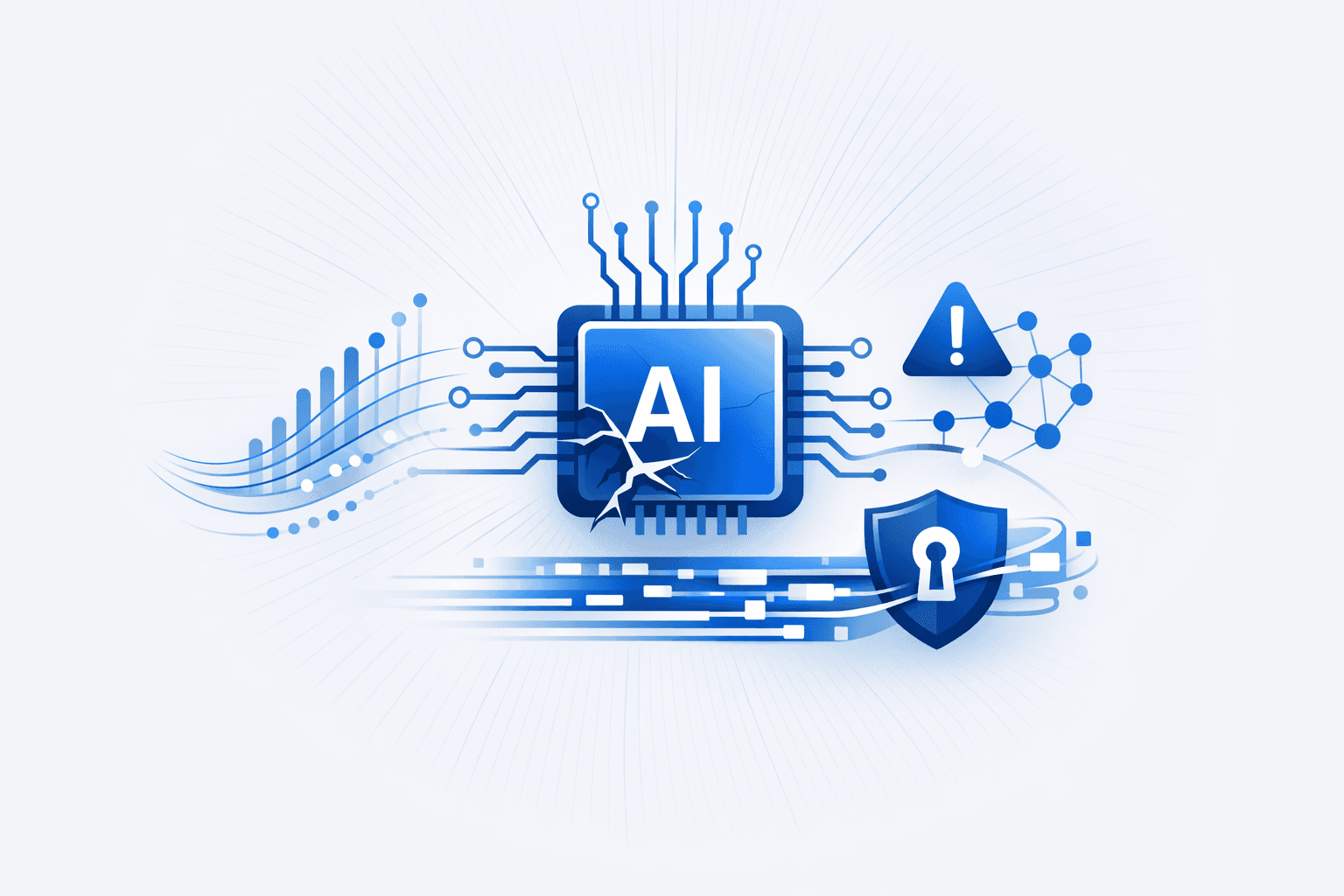
AI Adoption and Misuse Expands Enterprise and Cybercrime Risk
Emerging Technology Risk · 2 sources · Updated 5mo ago · First seen Feb 24, 2026

No single incident ties the reporting together; the dominant theme is AI’s expanding role in both enterprise operations and criminal tradecraft, alongside broader, non-AI security trend commentary. A Docker-sponsored survey reported by Help Net Security says 60% of organizations run AI agents in production, but security/compliance is the top scaling barrier (40%), with recurring concerns including prompt injection, tool poisoning, runtime isolation/sandboxing, auditability, and credential/access control in distributed agent systems. Separately, forum-traffic research summarized by Help Net Security found cybercriminals increasingly using mainstream and local AI models to support phishing, code generation, and social engineering, with frequent discussion of jailbreaking and the use of stolen/resold premium AI accounts.
Several other items are adjacent but not about the same specific story: an ESET article provides generic guidance on detecting AI voice deepfakes used for fraud; an Ars Technica piece covers copyright/data memorization risks in LLMs; and multiple outlets publish broader security trend or opinion content (quantum preparedness, ransomware targeting manufacturing, Romanian warnings about ransomware aligning with Russian hybrid aims, ATM jackpotting increases, and a Check Point retrospective). Some entries are primarily commentary, historical analogy, newsletters, or how-to recon guidance rather than new threat reporting, and should be treated as lower-signal for executive situational awareness unless your organization is actively deploying agentic AI or tracking AI-enabled fraud/social engineering.
Why it matters
Impact assessment
AI-related risk is expanding on two fronts: enterprise adoption of agentic AI is creating new exposure in internal workflows, and cybercriminals are increasingly using AI to scale phishing, fraud, and social engineering. The most affected organizations are those deploying AI agents in production, especially in telecommunications, financial services, and technology, as well as enterprises exposed to high-volume customer-facing fraud.
The immediate impact is primarily increased exposure rather than a single confirmed breach event. For enterprises, the main risks are unauthorized actions by agents, data leakage, weak credential handling, policy bypass, and governance gaps across multi-model and hybrid deployments; for defenders, the criminal-side trend points to higher-volume and more convincing phishing, vishing, and scam operations rather than a demonstrated step-change in malware sophistication.
Supporting details
- No single incident or named intrusion campaign ties the reporting together.
- Enterprise adoption is already broad: 60% of surveyed organizations reportedly run AI agents in production.
- Security and compliance are the top scaling barrier for 40% of respondents, indicating widespread concern rather than isolated edge cases.
- Operational complexity is the top build challenge for 48% of respondents, increasing the likelihood of misconfiguration and weak oversight.
- Early enterprise use cases include DevOps/CI/CD optimization, security automation, process automation, and code generation/review, which can touch sensitive systems and privileged workflows.
- Criminal adoption appears widespread but still early-stage and experimental, concentrated on phishing, scripting, social-engineering rehearsal, and fraud-call automation.
- There are no confirmed exploitation-in-the-wild details for a specific CVE or malware family in this story, but there is clear evidence of active adversary interest and operational experimentation.
- Scope is broad for exposure investigation in organizations using agentic AI, and targeted-to-broad for fraud risk depending on sector, brand visibility, and customer interaction volume.