Mallory
← Back to News
financial-sector-threatstate-sponsored-espionageidentity-impersonation-fraudcredential-stealer-activity

UNC1069 Targets Crypto and Finance Firms Using Deepfake Meetings and ClickFix Malware Delivery

Sector Threat Intelligence · 17 sources · Updated 5mo ago · First seen Feb 10, 2026
UNC1069 Targets Crypto and Finance Firms Using Deepfake Meetings and ClickFix Malware Delivery

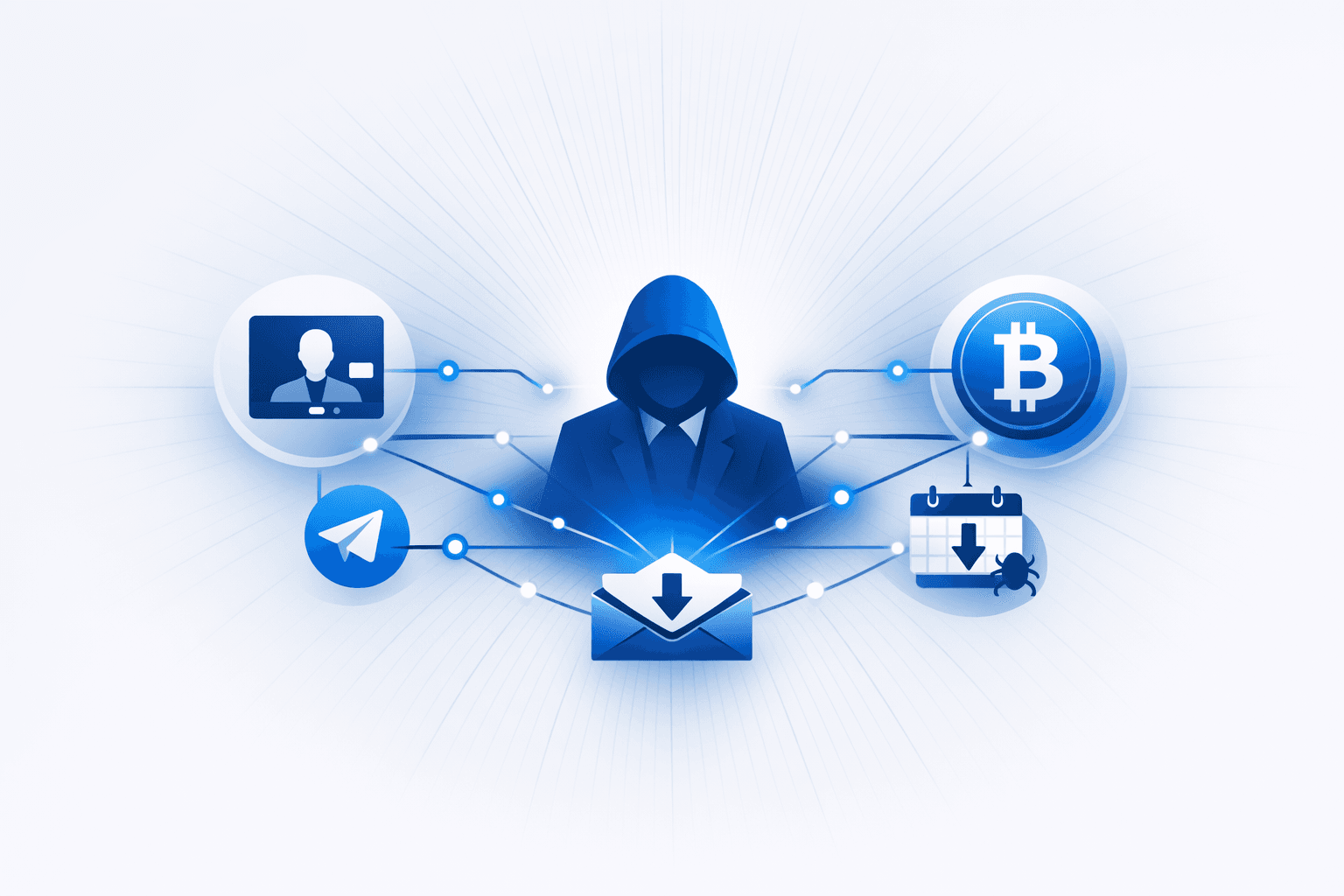
North Korean threat actor UNC1069 has escalated targeted intrusions against the cryptocurrency and broader finance sector by combining highly tailored social engineering with new malware tooling. Victims are approached via professional messaging platforms (notably Telegram) using recruiter/executive pretexts and, in at least one case, a compromised account of another crypto executive to increase credibility. Lures include scheduling links (e.g., Calendly) that lead to spoofed video meetings; incident reporting described a call where the victim was shown what appeared to be a deepfake video of a crypto CEO, though responders noted they could not independently verify AI model use in that specific instance.

During the meeting, operators feign technical issues and direct the target to “fix” audio/video problems—an example of the ClickFix technique—by running provided troubleshooting steps. The embedded command sequence contains a malicious line that initiates infection; in the documented case, this resulted in macOS compromise and deployment of backdoors identified as WAVESHAPER and HYPERCALL, enabling follow-on tool delivery and persistence. Reporting attributes the campaign’s objective to credential/session token and browser data theft to facilitate financial theft (e.g., draining crypto wallets), and notes an expanded toolkit observed on victim hosts, including multiple distinct malware families (custom backdoors and browser extensions) intended to bypass defenses and maximize data extraction before detection.

Why it matters

Impact assessment

UNC1069 is targeting cryptocurrency, Web3, fintech, venture capital, exchanges, wallet infrastructure, and broader finance-sector personnel with highly tailored fake-meeting lures that lead to endpoint compromise and theft of credentials, session tokens, browser data, and wallet-related information. The impact is severe because successful compromise can enable direct cryptocurrency theft, long-lived persistence, identity abuse for follow-on social engineering, and theft of sensitive enterprise and personal data.

Scope and severity

  • Affected populations include executives, founders, software developers, investors, legal/finance contacts, and other high-value users with access to crypto assets or strategic systems.
  • Exposure is targeted rather than indiscriminate, but the campaign is broad and sustained across multiple organizations and countries.
  • Arctic Wolf reported victims in more than 20 countries, with the United States representing 41% of identified victims.
  • Arctic Wolf reported CEOs and founders accounted for 45% of identified targets.
  • One victim retained attacker access for 66 days, showing meaningful operational persistence.
  • Reported outcomes include theft of browser credentials, Telegram session data, webcam footage, Apple Notes data, cookies, Keychain data, and cryptocurrency wallet-related information.
  • Stolen webcam footage and identity data were reused to improve future lures, increasing downstream exposure beyond the initial victim.

Known exploitation

  • Multiple references describe active exploitation in the wild against real victims.
  • Mandiant investigated a fintech/cryptocurrency-sector intrusion in which a macOS victim executed ClickFix commands and was infected.
  • Arctic Wolf documented a BlueNoroff-linked intrusion chain completing in under five minutes.
  • Reporting consistently links the campaign to financially motivated North Korean operations associated with UNC1069, Bluenoroff, and Lazarus-linked clusters.

Extracted entities by reference

Mandiant/press-derived UNC1069 reporting
  • Threat actor: UNC1069
  • Sectors: cryptocurrency, Web3, fintech, finance, venture capital, payments, brokerage, wallet infrastructure
  • Platforms: macOS, Windows; some reporting also includes Linux
  • Malware/tooling: WAVESHAPER, HYPERCALL, HIDDENCALL, SILENCELIFT, DEEPBREATH, SUGARLOADER, CHROMEPUSH, BIGMACHO
  • Tactic: fake Zoom meetings, deepfake or reused victim video, ClickFix troubleshooting prompts
Arctic Wolf / BlueNoroff reporting
  • Threat actor: BlueNoroff
  • Aliases: APT38, Sapphire Sleet, Stardust Chollima
  • Sectors: Web3, cryptocurrency, financial services
  • Scale: more than 20 countries; 80+ typo-squatted Zoom/Teams domains; 950+ files on attacker media server
  • Impact details: browser credential theft, Telegram session theft, webcam theft, persistence for 66 days
Mach-O Man reporting
  • Threat actor: Lazarus Group / Chollima / Famous Chollima
  • Sectors: fintech executives, crypto developers, Web3 professionals
  • Platforms: Intel and Apple Silicon Macs
  • Impact details: browser credential theft, Keychain theft, browser-extension inventory, Telegram-based exfiltration

Who's targeting your sector?See the actors and campaigns active against you right now.
See sector threats
Event timeline

How this story unfolded

Events from the most recent confirmed update back to the earliest known activity.

10 events · Jan 1, 2018 – Apr 28, 2026
  1. Apr 28, 20267mo ago

    Arctic Wolf details BlueNoroff fake Zoom campaign reusing victim video

    On 2026-04-28, Arctic Wolf reported that BlueNoroff was targeting cryptocurrency executives through fake Zoom meetings that harvested webcam footage for reuse in later social-engineering lures, alongside ClickFix-style malware delivery. The report added new operational details, including compromise in under five minutes, persistence lasting 66 days in one case, and infrastructure comprising more than 80 typo-squatted Zoom and Teams domains.

    BlueNoroff Uses Fake Zoom Calls to Turn Victims Into Attack Lures
  2. Apr 20, 20267mo ago

    Validin links UNC1069 campaign to Axios NPM compromise and Bluenoroff overlaps

    In April 2026, Validin researchers linked UNC1069's fake-meeting malware campaign to the Axios NPM package compromise and reported overlaps with the Bluenoroff cluster previously discussed by Mandiant. This added a new technical and attributional connection between the social-engineering operation and broader North Korean intrusion activity.

    North Korea-Linked UNC1069 Uses Fake Zoom and Teams Meetings to Hack Crypto Professionals
  3. Apr 14, 20268mo ago

    Researchers reveal UNC1069 fake meeting sites capture live audio and video

    In reporting published on 2026-04-14, researchers said UNC1069’s spoofed Zoom, Google Meet, and Microsoft Teams meeting pages could capture and stream victims’ microphone and camera feeds in real time and locally record them. The capability supports follow-on impersonation and social engineering against cryptocurrency, Web3, and financial-sector targets.

    "Hello? I can’t hear you": Investigating UNC1069’s Fake Meeting Tactics | Validin
  4. Apr 13, 20268mo ago

    Researchers detail 'Mach-O Man' macOS malware kit and exposed C2 weaknesses

    On 2026-04-13, Bitso/Quetzal researchers described a macOS-focused Famous Chollima campaign using hijacked Telegram accounts, fake Zoom/Meet/Teams meeting pages, and ClickFix-style terminal execution to deploy a malware chain including teamsSDK.bin, profiling implants, minst2.bin persistence, and the macrasv2 stealer. The report also disclosed operational security failures in the attackers' infrastructure, including an unauthenticated Go C2 /info endpoint and an exposed Telegram Bot API token that could enable disruption.

    North Korea's Safari: Hunting for RATs - by Mauro Eldritch
  5. Feb 10, 202610mo ago

    Mandiant publicly reports UNC1069's AI-enabled crypto theft campaign

    On February 10, 2026, Mandiant's findings were publicly reported, attributing the campaign to UNC1069 and detailing its use of AI-enabled social engineering, deepfake video, ClickFix execution, and newly identified malware. The disclosure highlighted the group's intensified focus on cryptocurrency and finance-sector victims.

  6. Feb 10, 202610mo ago

    Attackers deploy expanded malware set including new macOS tools

    Following initial access in the investigated intrusion, UNC1069 deployed an unusually large toolset on the victim host, including up to seven malware families such as WAVESHAPER, HYPERCALL, SUGARLOADER, SILENCELIFT, DEEPBREATH, and CHROMEPUSH. The tooling was used to steal credentials, browser and session data, Telegram and Apple Notes data, keystrokes, and other information to support cryptocurrency theft and future impersonation.

  7. Feb 10, 202610mo ago

    UNC1069 conducts tailored ClickFix and deepfake intrusion against a fintech/crypto victim

    In the incident investigated by Mandiant, attackers used a compromised cryptocurrency executive's Telegram account, a Calendly invite, and a spoofed Zoom meeting featuring an apparent deepfake CEO video to trick a victim into running ClickFix-style commands. The commands initiated infection on macOS, with reporting indicating the broader campaign also targeted Windows systems.

  8. Jan 1, 20252y ago

    UNC1069 targets financial services and crypto infrastructure in 2025

    Reports state that during 2025 UNC1069 was active against financial services and cryptocurrency-related verticals such as payments, brokerage, and wallet infrastructure. This reflects a continued expansion and concentration of the group's financially motivated operations.

  9. Jan 1, 20234y ago

    UNC1069 shifts targeting toward Web3 and cryptocurrency organizations

    By 2023, UNC1069 had moved away from more traditional spear-phishing and traditional financial-sector targets toward Web3 entities, including exchanges, software developers, venture capital personnel, and other cryptocurrency-related organizations. Multiple reports describe this as a strategic evolution in the group's targeting.

  10. Jan 1, 20189y ago

    UNC1069 begins activity tracked by Mandiant

    Mandiant says the North Korea-linked, financially motivated threat actor UNC1069 has been active since at least 2018. This establishes the earliest known baseline for the group's operations.

Linked entities

Related entities

Vulnerabilities, threat actors, malware, products, organizations, breaches, and observables Mallory has linked to this story. Indicator values are masked here and available in full in the app.

Open in app →

Threat actors

1 linked

Malware

2 linked

Observables

67 linked

Indicator values are masked on this page. View all 67 in Mallory Domains, IPs, hashes, and URLs are exportable to your SIEM.

Do you run this?See the adversaries and campaigns active against your sector right now, ranked by what they're exploiting.
See Your Sector's Threats
Mallory platform

See the full picture, correlated to your attack surface.

This page covers what’s public. Mallory adds the parts that aren’t: which of your assets are affected, which threat actors are using it right now, and what to deploy next.

Exposure mappingMap indicators from this story to your assets and identify affected systems in minutes.
Threat actor evidenceEvery observed campaign, victim, and pivot linked to actors named in this story.
Associated malwareMalware, exploits, and IOCs connected to the activity described here.
Detection signaturesYARA, Sigma, and Snort rules deployed to your SIEM as soon as they’re published.
Scheduled alertsGet matching new stories delivered to your team as they break, not the next morning.
AI threadsAsk questions about this story and take action on the answers.